
Maleic Acid (CAS 110-16-7) | 99.5% Purity
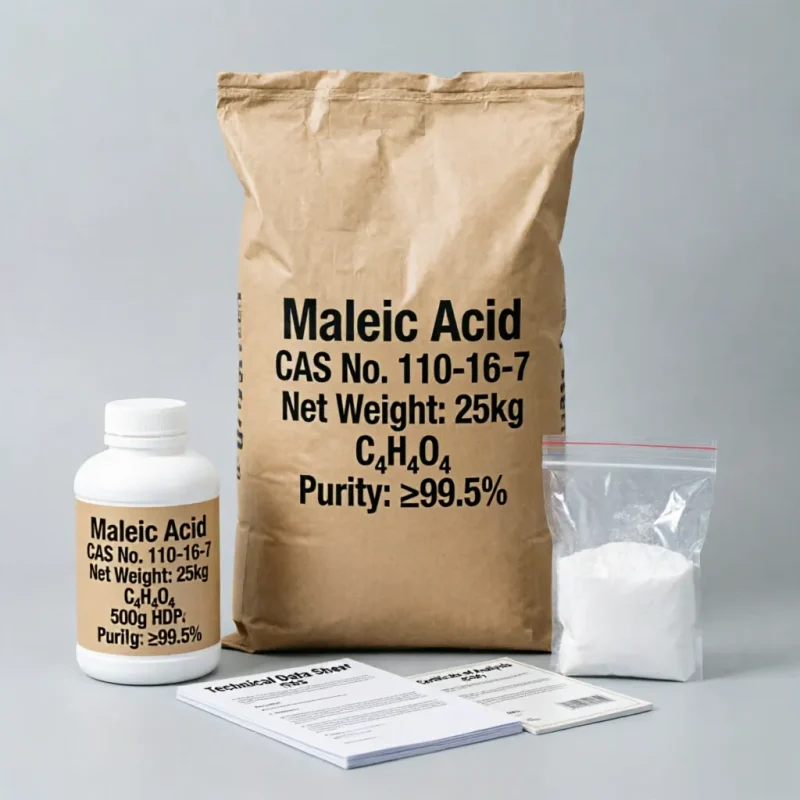
Maleic Acid is the cis-isomer of butenedioic acid supplied as white crystalline powder or flakes with a characteristic tart odor. Its highly reactive carbon-carbon double bond and two carboxyl groups make it an essential monomer for unsaturated polyester resins (UPR), agricultural intermediates, and water treatment polymers. Each shipment includes COA, TDS, and SDS.
- CAS No: 110-16-7
- Synonyms: cis-Butenedioic acid, Toxic acid, (Z)-Butenedioic acid, Maleic acid
- EC Number: 203-742-5
- Molecular Formula: C4H4O4
- Molecular Weight: 116.07 g/mol
- Appearance: White crystalline powder or flakes
- Purity: ≥ 99.5%
- Packaging: 25 kg (55 lb) woven PP bag with PE liner; 25 kg (55 lb) multi-wall paper bag; 1000 kg (2200 lb) FIBC jumbo bag. Custom packaging available upon request.
- Main Applications: Unsaturated polyester resins (UPR), agrochemical synthesis, water treatment scale inhibitors, paper sizing agents
Introduction to Maleic Acid
Maleic Acid is the cis-configured isomer of butenedioic acid, featuring two carboxylic acid groups on the same side of a rigid carbon-carbon double bond. This structural “kink” prevents tight molecular packing, making it highly soluble in water and exceptionally reactive in esterification and copolymerization. The global composite and agrochemical industries consume the bulk of production, utilizing it to introduce flexible cross-linking sites into polymer chains or to synthesize organophosphate pesticides.
The primary processing advantage is its ability to disrupt polymer crystallinity, which is critical for manufacturing flexible unsaturated polyester resins (UPR) used in fiberglass composites. The critical storage risk is thermal and moisture-induced isomerization. If exposed to heat or prolonged humidity, Maleic Acid slowly converts into its trans-isomer, Fumaric Acid. Fumaric Acid has drastically lower water solubility and different reactivity, which can ruin aqueous formulations and resin batches. Store bags in a dry, climate-controlled warehouse below 25 °C (77 °F).
Key Features of Maleic Acid
- Essential UPR monomer. The cis-configuration introduces structural irregularities into polyester chains, preventing crystallization and enabling proper styrene cross-linking for fiberglass-reinforced plastics.
- High aqueous solubility. Dissolves readily in water (approx. 44 g/100 mL at 25 °C), making it superior to its anhydride or fumaric counterparts for manufacturing water-based polycarboxylate superplasticizers and scale inhibitors.
- Strong chelating precursor. The adjacent dicarboxylic structure serves as the backbone for synthesizing highly effective metal-ion chelating agents used in industrial water treatment and boiler scale prevention.
- Agrochemical building block. Serves as the primary raw material for synthesizing Malathion and other organophosphate insecticides, as well as plant growth regulators.
Maleic Acid Chemical & Physical Properties
| Property | Value |
|---|---|
| Molecular Formula | C4H4O4 |
| Molecular Weight | 116.07 g/mol |
| Thermal Behaviour | Melts at 130–139 °C (266–282 °F) with partial isomerization to Fumaric Acid and dehydration to Maleic Anhydride. |
| Density | Crystal density approx. 1.59 g/cm³ (99.3 lb/ft³); bulk powder density 0.80–0.95 g/cm³ (50–59 lb/ft³). |
| Solubility in Water | Highly soluble, approx. 44 g / 100 mL at 25 °C (77 °F); soluble in ethanol and acetone. |
| pH (10% aqueous solution) | 1.5 – 2.0 (Strongly acidic) |
| Acid Value | ~960 mg KOH/g |
| Heavy Metals (as Pb) | ≤ 10 ppm |
Applications of Maleic Acid
Unsaturated Polyester Resins (UPR): Copolymerized with glycols and phthalic anhydride to form the base resin for fiberglass composites. The cis-double bond provides the necessary chain flexibility and reactivity for subsequent styrene cross-linking, widely used in boat hulls, automotive parts, and sanitary ware.
Water Treatment and Construction Chemicals: Used as a monomer to synthesize polycarboxylate ether (PCE) superplasticizers for high-performance concrete, and polyepoxysuccinic acid (PESA), a biodegradable, non-phosphorus scale inhibitor for cooling towers and reverse osmosis systems.
Agrochemical Synthesis: Acts as the foundational intermediate for manufacturing organophosphate pesticides (e.g., Malathion) and various herbicide safeners, leveraging its reactive double bond for addition reactions.
Paper Sizing and Textile Auxiliaries: Reacted with rosin to produce maleated rosin sizes, improving the hydrophobicity and printability of packaging paper and cardboard.
Storage & Safety Precautions for Maleic Acid
- Storage: Keep tightly sealed in a cool, dry warehouse below 25 °C (77 °F). Avoid heat and direct sunlight, which trigger cis-to-trans isomerization into Fumaric Acid. Once a bag is opened, roll the PE liner tightly and use the material quickly to prevent moisture absorption and caking.
- Safety: Classified as GHS05 (Corrosive). Causes severe skin burns and serious eye damage. Always wear acid-resistant gloves, a face shield, and an apron when handling dry powder. In case of contact, rinse immediately with copious amounts of water for at least 15 minutes and seek medical attention.
- Transport: Classified as Class 8 Corrosive (UN 2260, PG III) for IATA/IMDG/ADR. Must be shipped in properly labeled, UN-certified packaging, segregated from strong oxidizers and alkalis.
- QC note: Verify purity via acid-base titration. Critical field test: Dissolve 10 g of powder in 100 mL of distilled water at room temperature. It must dissolve completely clear. If a gritty, white insoluble residue remains, the lot has partially isomerized into Fumaric Acid due to heat exposure during transit—reject the shipment.
Maleic Acid FAQ
Q: How does Maleic Acid differ from Fumaric Acid?
A: They are geometric isomers. Maleic Acid is the cis-isomer, highly soluble in water, and reactive. Fumaric Acid is the trans-isomer, nearly insoluble in water, and chemically stable. Maleic acid is used for resins and water-treatment polymers; Fumaric acid is primarily used as a food acidulant (E297).
Q: Can I use Maleic Acid instead of Maleic Anhydride for resin production?
A: Yes, but with adjustments. Maleic Anhydride is preferred for UPR because it avoids generating water during esterification. If using Maleic Acid, the reactor must be equipped with an efficient water-removal (azeotropic distillation) system to drive the equilibrium forward and achieve high molecular weights.
Q: Why did my Maleic Acid powder develop hard lumps?
A: Hard lumps indicate moisture ingress. Maleic Acid is hygroscopic. While mild caking can sometimes be broken up, prolonged moisture exposure accelerates isomerization to Fumaric Acid. Always inspect the PE liner for tears upon receipt and store pallets away from exterior warehouse walls.
Related products
Manufacturer & Exporter Since 2006
Get Tailored Chemical Raw Material Solutions — Reply Within 1 Hour
Factory-direct pricing, stable high-purity supply and complete compliance documentation for your industrial formulations.
- 1000+Products
- 200+QC Protocols
- 7–15Days Delivery
- Factory-Direct Pricing
- COA / TDS / SDS Included
- Free Samples for Testing
- 40+ Export Countries
Request a Free Quote
Our engineers reply within 1 hour during GMT+8 business hours.
Please include in your inquiry:
- Product name or CAS number
- Required quantity
- Destination country or port
- Preferred packaging