
Chloroxylenol PCMX CAS 88-04-0
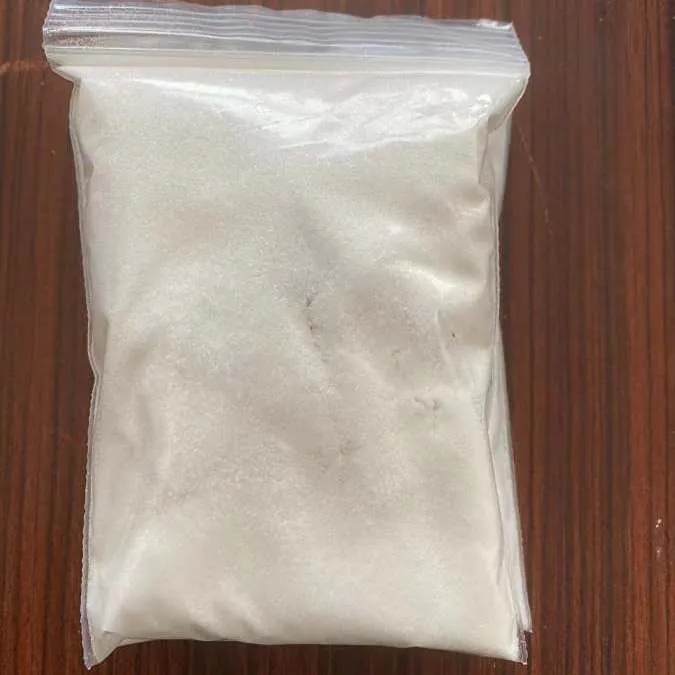
Chloroxylenol (PCMX) is a chlorinated dimethylphenol supplied as white to off-white crystals or powder. It serves as an antimicrobial active in antiseptic soaps, skin disinfectants, and surface biocides. Its 4-chloro-3,5-dimethylphenol structure raises bactericidal potency and lowers water solubility. Each lot ships with COA, TDS, and SDS.
- CAS No: 88-04-0
- Synonyms: PCMX, p-Chloro-m-xylenol, 4-Chloro-3,5-dimethylphenol
- EINECS: 201-793-5
- Molecular Formula: C8H9ClO
- Molecular Weight: 156.61 g/mol
- Appearance: White to off-white crystalline powder
- Purity: 99.0% min by GC
- Melting Point: 64-67 °C (147-153 °F)
- Solubility: About 0.3 g/L (300 mg/L) in water at 25 °C (77 °F); soluble in alcohols and alkali
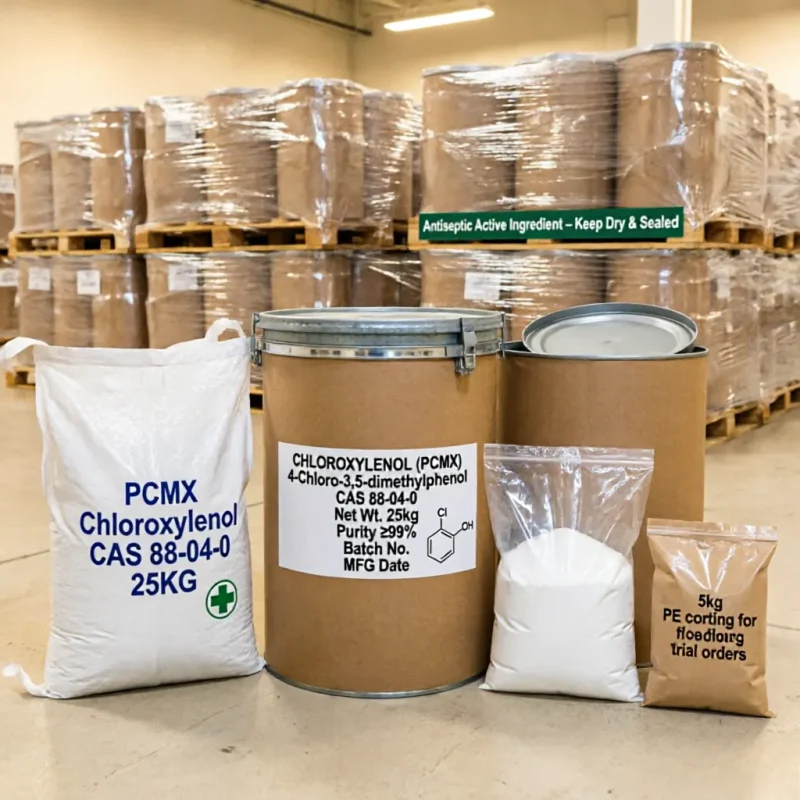
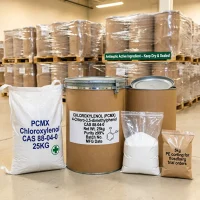
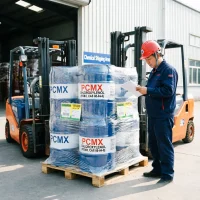
- Packaging: 25 kg fiber drum with PE liner. Custom packaging available upon request.
- Main Applications: Antiseptic disinfectants, antibacterial soaps, industrial preservatives
Introduction to Chloroxylenol
Chloroxylenol is a white to off-white crystalline chlorinated phenolic antiseptic built on a 4-chloro-3,5-dimethylphenol skeleton. The para-chloro group and two methyl groups increase lipid affinity and microbial membrane disruption. It is mainly used in hospital surface disinfectants and antibacterial soaps. It is supplied as technical powder for formulators compounding disinfectant concentrates and antiseptic soap bases.
The main formulation advantage is very low aqueous solubility, about 0.3 g/L (300 mg/L) at 25 °C (77 °F), which keeps the active tightly associated with organic soil and lipid-rich contamination. The same low solubility is the main practical pitfall: without adequate alcohol, glycols, or surfactant solubilizers, PCMX readily recrystallizes during dilution or cold warehouse storage, ruining batch clarity.
Key Features of Chloroxylenol
- Chlorinated phenolic nucleus: The 4-chloro-3,5-dimethyl substitution pattern increases lipophilicity and membrane penetration for targeted microbial disruption.
- Low aqueous loss: Solubility near 0.3 g/L (300 mg/L) at 25 °C (77 °F) keeps PCMX associated with organic soil, although clear aqueous formulas need solubilizers.
- Alkali-soluble phenolate behavior: In alkaline solutions PCMX converts to water-soluble phenolate salts, allowing liquid concentrates with reduced solvent load.
- Crystalline handling range: A 64-67 °C (147-153 °F) melting range, verified by ASTM E324, supports powder handling; prolonged storage near 40 °C (104 °F) can cause caking.
- Anionic soap compatibility: Chloroxylenol can be emulsified in soap and anionic surfactant systems, which suits antiseptic liquid soap formulations.
Chloroxylenol Chemical & Physical Properties
| Property | Value |
|---|---|
| Molecular Formula | C8H9ClO |
| Molecular Weight | 156.61 g/mol |
| Appearance | White to off-white crystalline powder |
| Melting Point | 64-67 °C (147-153 °F) |
| Boiling Point | 263 °C (505 °F) at 101.3 kPa (1 atm) |
| Density | 1.15 g/cm³ (9.6 lb/gal) |
| Flash Point | 121 °C (250 °F), closed cup |
| Solubility in Water | About 0.3 g/L (300 mg/L) at 25 °C (77 °F) |
| Solubility in Organic Solvents | Soluble in ethanol, isopropanol, acetone, and glycols; soluble in alkaline solutions |
| pKa | About 9.7 |
| Vapor Pressure | Low at 25 °C (77 °F) |
Applications of Chloroxylenol
Hospital and household disinfectants: PCMX disrupts bacterial cell membranes and denatures cytoplasmic proteins. Emulsion concentrates commonly contain 0.5-4.8% PCMX, solubilized with soap or nonionic surfactant, then diluted at 15-30 °C (59-86 °F) before surface wiping.
Antibacterial soaps and skin cleansers: In wash-off formulations, the phenolic active partitions into sebum and surface debris. Typical loading is 0.2-2.0%, with surfactant systems adjusted to avoid recrystallization during shelf storage at 10-35 °C (50-95 °F).
Instrument and hard-surface cleaning: PCMX provides antimicrobial action in detergent blends where anionic surfactants are present. Use levels often fall between 0.1-1.0% in diluted working solutions, usually prepared at 15-30 °C (59-86 °F), depending on soil load and contact time.
Textile, leather, and household preservative systems: The chlorinated phenol inhibits mold and bacteria by disrupting microbial enzyme and membrane functions. It is typically added at 0.05-0.5% in preservative concentrates where pH and solvents keep it dissolved.
Storage & Safety Precautions for Chloroxylenol
Store in tightly closed drums at 5-30 °C (41-86 °F) in a dry, shaded area. Keep away from strong oxidizers and alkaline solutions, because alkali contact converts PCMX into a difficult-to-handle liquid phenolate. Avoid stacking near heat sources to prevent caking or softening near the 64-67 °C (147-153 °F) melting point, and monitor poorly sealed drums for darkening caused by phenolic oxidation.
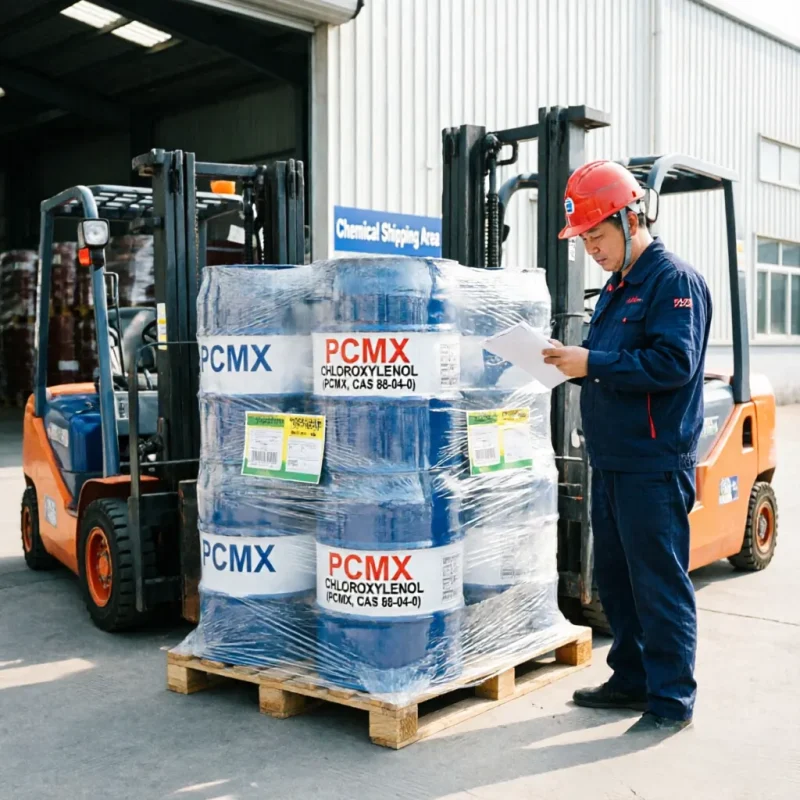
Wear nitrile gloves, goggles, and a dust mask during handling, and use local exhaust when charging mixers. Sweep spills into labeled containers without raising dust; never wash into drains. Treat PCMX as harmful if swallowed, irritating to skin and eyes, and toxic to aquatic life (H302, H315, H319, H410). Ship 25 kg drums as Non-DG after verifying SDS Section 14; use PE liners and keep cargo away from open flames due to the 121 °C (250 °F) closed-cup flash point.
Chloroxylenol (PCMX) FAQ
Q: Why does Chloroxylenol recrystallize when a disinfectant concentrate is diluted?
A: Recrystallization usually signals solubility failure, not degradation. PCMX dissolves only 0.3 g/L in water at 25 °C (77 °F). Dilution lowers solvent strength, causing haze or crystals. Add sufficient solubilizers before dilution, test at 5 °C (41 °F) for 7 days, and inspect the diluted product. If crystals persist, adjust the surfactant ratio and rework.
Q: How should formulators solubilize Chloroxylenol CAS 88-04-0 in clear aqueous systems?
A: Clear aqueous systems require pre-solubilization. Dissolve PCMX in isopropanol, neutralize with alkali to form phenolate, or emulsify with castor-oil soaps or nonionic surfactants. Route choice depends on pH and foam. QC should dilute to use rate, cycle between 40 °C (104 °F) and 5 °C (41 °F), and retain samples to monitor clarity and color drift.
Q: What QC tests confirm incoming Chloroxylenol powder meets specification?
A: Start with GC assay and melting range. Technical PCMX requires ≥99.0% purity and sharp melt near 64-67 °C (147-153 °F) per ASTM E324. Broad melting indicates moisture or isomers. Reject darkened lots; phenolic oxidation changes product color. Check ethanol and dilute-alkali dissolution. Verify antimicrobial performance in the finished formula, not only certificates. Retain samples for storage drift.
Related products
Manufacturer & Exporter Since 2006
Get Tailored Chemical Raw Material Solutions — Reply Within 1 Hour
Factory-direct pricing, stable high-purity supply and complete compliance documentation for your industrial formulations.
- 1000+Products
- 200+QC Protocols
- 7–15Days Delivery
- Factory-Direct Pricing
- COA / TDS / SDS Included
- Free Samples for Testing
- 40+ Export Countries
Request a Free Quote
Our engineers reply within 1 hour during GMT+8 business hours.
Please include in your inquiry:
- Product name or CAS number
- Required quantity
- Destination country or port
- Preferred packaging