
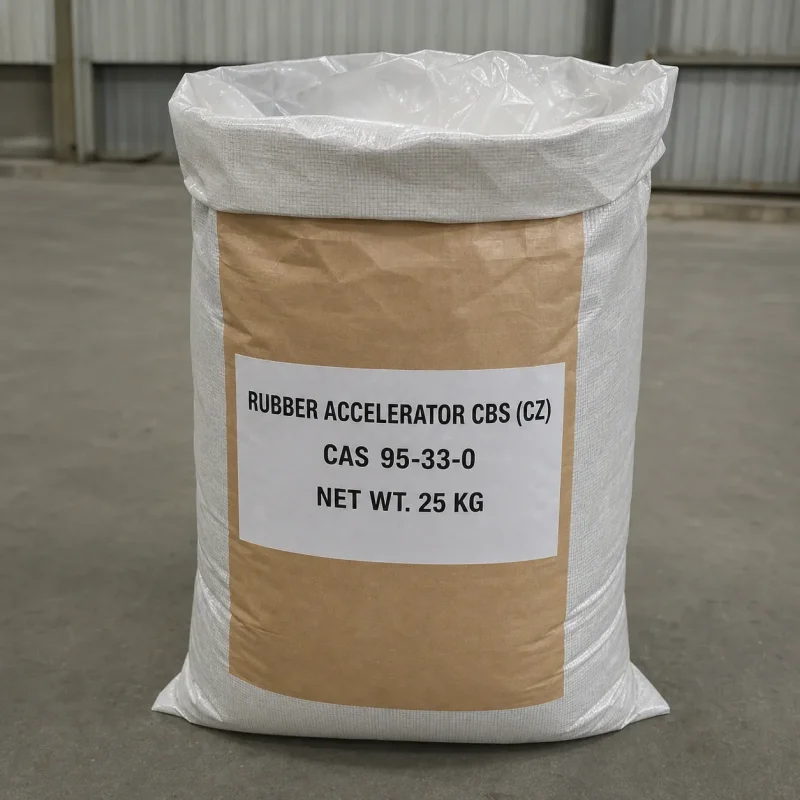
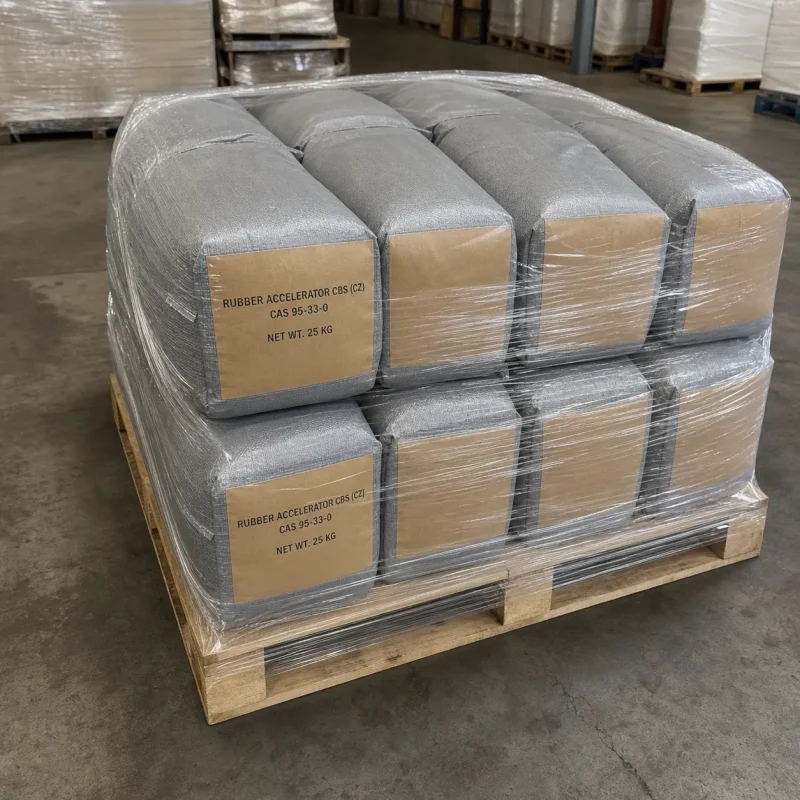
Rubber Accelerator CBS (CZ) CAS 95-33-0
Rubber Accelerator CBS (CZ) is a sulfenamide-type delayed-action vulcanization accelerator supplied as white to light-yellow crystalline powder or granules. Its S–N bond gives 5–10 min scorch delay at 120 °C (248 °F), then rapid sulfur crosslinking at 145–155 °C (293–311 °F), making it the main accelerator for tire tread, sidewall, conveyor-belt, hose, and shoe-sole compounds. Each shipment includes COA, TDS, and SDS.
- CAS No: 95-33-0
- Synonyms: CZ, N-Cyclohexyl-2-benzothiazolesulfenamide, Vulcanoc CZ, Santocure CBS
- EINECS: 202-412-8
- Molecular Formula: C13H16N2S2
- Molecular Weight: 264.41 g/mol
- Appearance: White to light-yellow crystalline powder or granules
- Purity: ≥ 98.0% (HPLC)
- Melting Point: ≥ 95.0 °C (≥ 203.0 °F)
- Heating Loss: ≤ 0.30%
- Packaging: 25 kg (55 lb) woven PP bag with PE liner; 20 kg (44 lb) kraft bag. Custom packaging available upon request.
- Main Applications: Tire tread/sidewall, conveyor belts, hoses, shoe soles, cable jackets
Introduction to Rubber Accelerator CBS
Rubber Accelerator CBS (CZ) is a white-to-cream sulfenamide accelerator whose benzothiazole ring is linked to cyclohexylamine through an S–N bond. That S–N bond keeps the compound inert below 120 °C (248 °F), then cleaves at cure temperature to release the active 2-mercaptobenzothiazyl radical that bridges sulfur to NR, SBR, or BR chains. Tire plants and belt factories use most output, dosing 0.8–1.5 phr with 1.5–2.5 phr sulfur.
The main processing benefit of CBS is the balance between delayed onset and efficient cure. The S–N bond remains stable during mixing below 120 °C (248 °F), then activates predictably at 145–155 °C (293–311 °F), giving repeatable t90 in NR, SBR, and BR systems. The storage risk is heat: keep CBS below 35 °C (95 °F); above 40 °C (104 °F) hydrolysis can release cyclohexylamine odour, and near 90 °C (194 °F) granules may cake.
Key Features of Rubber Accelerator CBS
- Built-in scorch delay at mixing temperature. The sulfenamide S–N bond must cleave before the benzothiazyl radical activates sulfur, giving 5–10 min at 120 °C (248 °F) without adding PVI or other retarders.
- Single-accelerator cure for NR/SBR tread stocks. At 1.0–1.5 phr CBS with 2.0 phr sulfur, t90 is commonly 8–12 min at 150 °C (302 °F), supporting a one-accelerator system.
- No thiuram disulfide structure. CBS is often selected when nitrosamine control is required; confirm final article emissions with VDA 278 or the customer method.
- Stable response in high-silica compounds. At 1.0–1.8 phr, CBS usually keeps t90 within 1–2 min when silica rises from 30 to 80 phr with silane, but ZnO level and silane type still need MDR confirmation.
- Granule form lowers dust exposure. Oil-coated 1–3 mm (0.04–0.12 in) granules reduce airborne dust versus fine powder during weighing, helping control skin-sensitization risk under GHS H317.
Rubber Accelerator CBS Chemical & Physical Properties
| Property | Value |
|---|---|
| Molecular Formula | C13H16N2S2 |
| Molecular Weight | 264.41 g/mol |
| Melting Point | 95–102 °C (203–216 °F); typical specification ≥ 96 °C (≥ 205 °F) |
| Thermal Behaviour | No true boiling point; melts first, then decomposes on strong heating. Avoid prolonged heating above 120 °C (248 °F). |
| Density | Crystal density approx. 1.31 g/cm³ (81.8 lb/ft³); bulk powder density 0.45–0.55 g/cm³ (28.1–34.3 lb/ft³) |
| Dust Combustibility | Solid powder; dust may be combustible. Control ignition sources and dust accumulation. |
| Solubility | Insoluble in water, less than 0.01 g/L at 25 °C (77 °F); soluble in dichloromethane and chloroform; slightly soluble in acetone and toluene; insoluble in gasoline. |
| Ash Content | ≤ 0.30% (ASTM D482) |
| Heating Loss | ≤ 0.30% after 2 h at 105 °C (221 °F) |
| Sieve Residue | ≤ 0.1% on 150 µm (0.0059 in) sieve for powder grade |
Applications of Rubber Accelerator CBS
Passenger and truck tire tread / sidewall: CBS at 0.8–1.5 phr with 1.5–2.5 phr insoluble sulfur activates sulfur-ring opening and crosslinks NR/BR/SBR chains. The 5–10 min scorch window lets the compound pass extrusion and calendaring without pre-cure. Typical t90 at 150 °C (302 °F) is 9–12 min by MDR per ASTM D5289.
Conveyor belt covers and carcass plies: Dosed at 1.0–2.0 phr with ZnO/stearic-acid activation, CBS helps build crosslink density above 12 × 10⁻⁴ mol/cm³, supporting 15–20 MPa (2,175–2,900 psi) tensile strength and 450–550% elongation required by ISO 252 belt constructions. The delayed onset prevents scorch during multi-pass calendering of EP plies.
Industrial hoses and tubing (EPDM, NBR, CR): In NBR oil-seal hoses, 1.0–1.5 phr CBS with 0.3 phr TMTD as secondary shortens t90 to 6–8 min at 160 °C (320 °F) while keeping compression set below 25% by ASTM D395 Method B. The benzothiazole radical couples efficiently with nitrile-bound sulfur sites.
Shoe sole and microcellular rubber: At 0.5–1.0 phr in EVA/NR blends, CBS provides the gentle onset needed so blowing agent decomposition near 170 °C (338 °F) and sulfur cure overlap without collapsing cell structure. Typical sole hardness is 55–65 Shore A, with density 0.35–0.45 g/cm³ (21.8–28.1 lb/ft³).
Cable jackets and wire insulation (EPDM/XLPE): 1.0–1.5 phr CBS in EPDM jacket stocks keeps the compound scorch-free through continuous CV-line extrusion at 110–120 °C (230–248 °F), then cures fully in a 200 °C (392 °F) steam tube within 45–60 s residence time.
Storage & Safety Precautions for Rubber Accelerator CBS
- Storage: Keep CBS sealed at 5–35 °C (41–95 °F), relative humidity below 65%, away from direct sunlight, strong acids, and oxidizers. Above 40 °C (104 °F), the S–N bond can slowly hydrolyse and release cyclohexylamine odour. If bag temperature approaches 90 °C (194 °F), granules may sinter and cake.
- Safety: Treat CBS as a skin sensitiser (GHS H317). Wear nitrile gloves ≥ 0.4 mm (0.016 in), goggles, and FFP2/N95 dust protection. Sweep or vacuum spills and do not discharge to drains.
- Transport: CBS is Non-DG under IATA/IMDG/ADR. For ocean shipments over 21 days, use one 50 g (1.8 oz) desiccant per 25 kg (55 lb) bag.
- QC note: Check incoming melting point by DSC per ASTM E794. Capillary heating rates above 2 °C/min may read 2–3 °C (3.6–5.4 °F) low. Reject lots below 93 °C (199 °F) if accompanied by brown tint or strong amine odour.
Rubber Accelerator CBS FAQ
Q: How does CBS (CAS 95-33-0) differ from TBBS (NS), and can I switch one-for-one?
A: CBS and TBBS share the same benzothiazyl radical, so cured properties are close. CBS usually has shorter scorch and reaches t90 1–2 min faster at 150 °C (302 °F). For long extrusion below 130 °C (266 °F), TBBS is safer. Confirm substitution by MDR ASTM D5289 and Mooney scorch ASTM D1646.
Q: My CBS arrived pale yellow instead of white. Is it degraded?
A: Pale yellow tint is usually slight oxidation, not degradation. Accept if melting point is ≥ 95 °C (203 °F) and HPLC is ≥ 97.5%. Reject if brown, strong cyclohexylamine odour appears, or melting point is below 93 °C (199 °F). Decide by MDR ASTM D5289, not colour alone.
Q: Can I replace M or DM with CBS without changing sulfur?
A: Not directly. CBS has delayed cure onset. With unchanged sulfur, replacing 1.0 phr M with 1.0 phr CBS usually delays t90 by 2–4 min at 150 °C (302 °F). Raise temperature about 5 °C (9 °F) or add 0.2–0.3 phr DPG, then recheck MDR and ISO 6502 data.
Q: What activator system works best with CBS in a 70+ phr silica tread?
A: Use 2.0–3.0 phr ZnO and 1.5–2.0 phr stearic acid; high-silica stocks use the upper stearic range. CBS 1.2–1.8 phr with 1.8–2.2 phr insoluble sulfur gives t90 10–14 min at 160 °C (320 °F). If t90 drifts long, add 0.2 phr DPG, not more than 2.0 phr CBS.
Related products
Manufacturer & Exporter Since 2006
Get Tailored Chemical Raw Material Solutions — Reply Within 1 Hour
Factory-direct pricing, stable high-purity supply and complete compliance documentation for your industrial formulations.
- 1000+Products
- 200+QC Protocols
- 7–15Days Delivery
- Factory-Direct Pricing
- COA / TDS / SDS Included
- Free Samples for Testing
- 40+ Export Countries
Request a Free Quote
Our engineers reply within 1 hour during GMT+8 business hours.
Please include in your inquiry:
- Product name or CAS number
- Required quantity
- Destination country or port
- Preferred packaging