
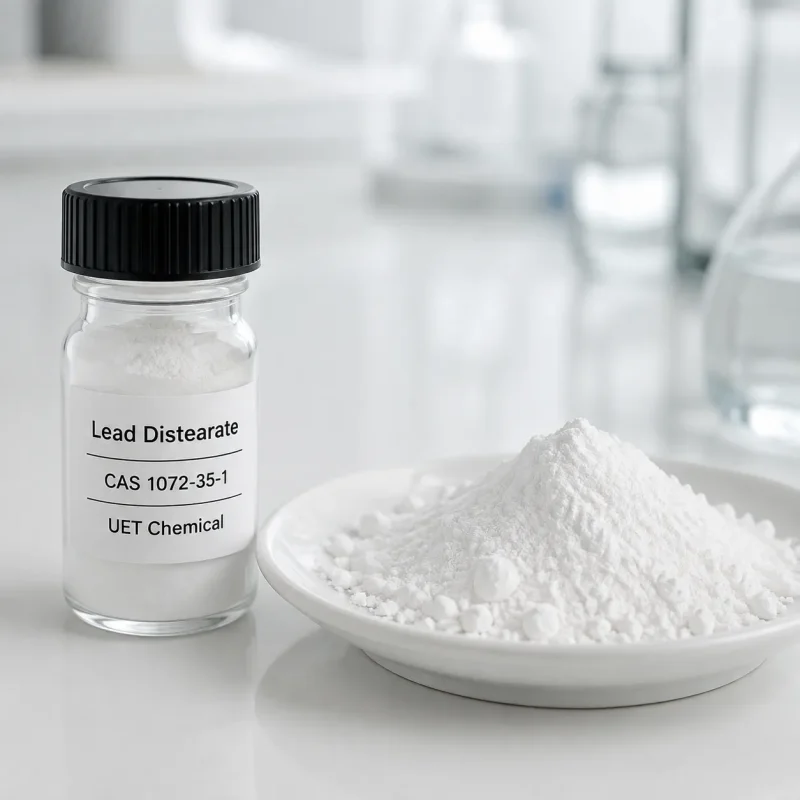
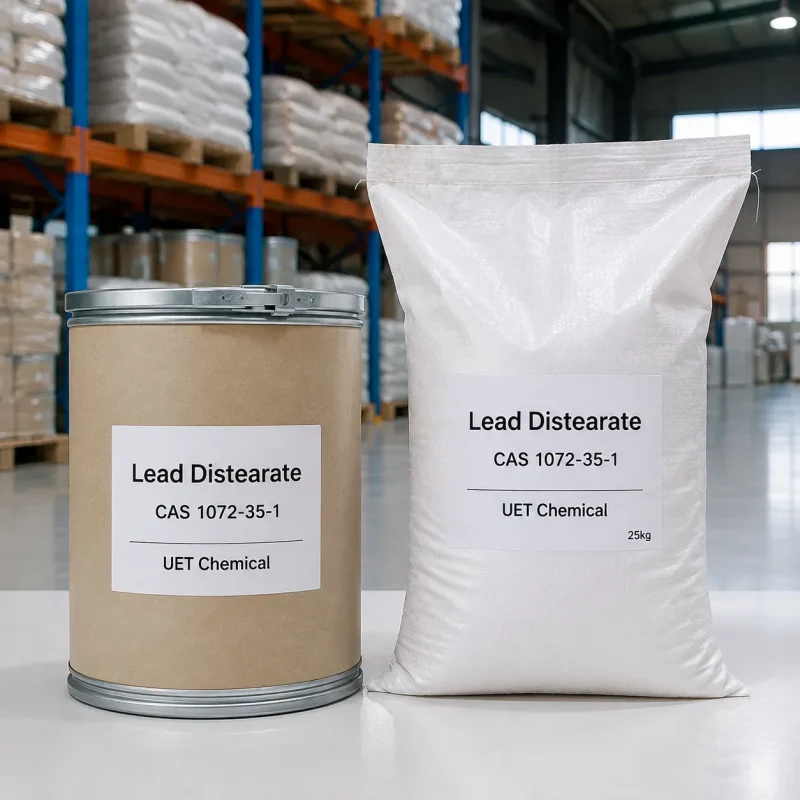
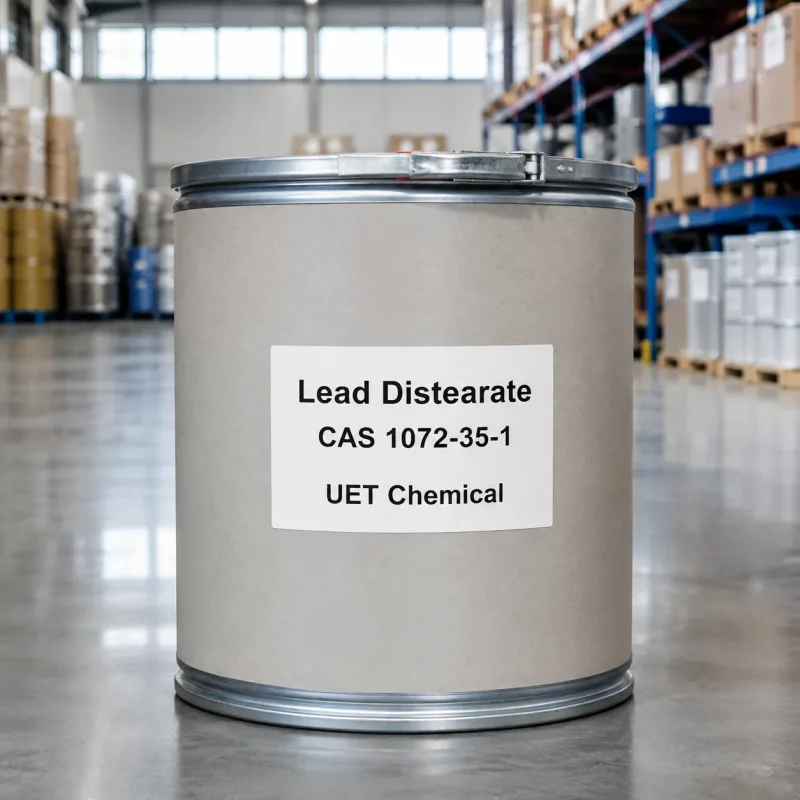
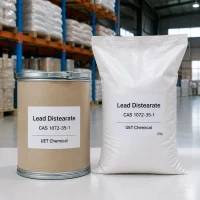
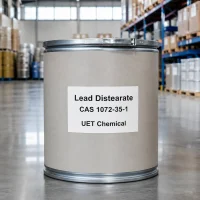
Lead Distearate CAS 1072-35-1
Lead Distearate is a metallic stearate salt featuring a lead cation coordinated with two stearate chains, supplied as a fine white powder. It acts as a primary heat stabilizer and external lubricant, making it critical for rigid PVC pipe extrusion and cable jacketing. UETChem also supplies this product with strict control over lead content and free acid to ensure consistent thermal stability. Each shipment includes COA, TDS, SDS.
- CAS No: 1072-35-1
- Synonyms: Lead stearate; Plumbous stearate; Dibasic lead stearate
- EINECS: 214-022-5
- Molecular Formula: C36H70O4Pb
- Molecular Weight: 774.13 g/mol (774.13 lb/lbmol)
- Appearance: Fine white powder
- Melting Point: 105-115 °C (221-239 °F)
- Lead Content: 26.5-27.5%
- Free Acid: 1.0% max
- Packaging: 25 kg (55 lb) bag, 500 kg (1102 lb) pallet. Custom packaging available upon request.
- Main Applications: PVC heat stabilizer, external lubricant, paint drier, rubber vulcanization agent
Introduction to Lead Distearate
Lead Distearate is an organometallic compound built around a central lead atom bonded to two long-chain C18 stearate groups. Plastic compounders rely on it to neutralize hydrochloric acid released during PVC degradation and to reduce melt friction against extruder barrels.
The material melts between 105–115 °C (221–239 °F), forming a protective boundary film. Moisture is the main processing risk. Wet powder hydrolyzes to form stearic acid and lead hydroxide, destroying the stabilizing effect and causing plate-out on calender rolls. Always verify the free acid and moisture specs before blending into high-shear mixers.
Key Features of Lead Distearate
- HCl scavenging: The lead stearate structure reacts with hydrogen chloride gas released by degrading PVC, stopping the autocatalytic degradation cycle.
- External lubrication: The long C18 hydrocarbon chains migrate to the melt-metal interface, lowering torque and preventing melt fracture in rigid profiles.
- Synergy with other stabilizers: Blending with barium or cadmium salts broadens the thermal stability window. Formulators often pair it with Stearic Acid to adjust the initial melt viscosity.
- Low volatility: High molecular weight prevents vaporization and die drool at standard extrusion temperatures up to 200 °C (392 °F).
Lead Distearate Chemical & Physical Properties
| Property | Value |
|---|---|
| Molecular Formula | C36H70O4Pb |
| Molecular Weight | 774.13 g/mol (774.13 lb/lbmol) |
| Melting Point | 105-115 °C (221-239 °F) |
| Density | 1.37 g/cm³ (11.4 lb/gal) at 20 °C (68 °F) |
| Solubility | Insoluble in water; soluble in hot ethanol and ether |
| Lead Content | 26.5-27.5% |
| Free Acid (as Stearic Acid) | 1.0% max |
| Moisture | 0.5% max |
Applications of Lead Distearate
Rigid PVC extrusion: Dosed at 1.0–3.0 phr in pipe and window profile formulations. It neutralizes HCl and provides late-stage lubrication, allowing higher screw speeds without burning the melt. Compounders frequently combine it with Paraffin Wax to balance early and late lubrication.
Cable and wire jacketing: Used at 2.0–5.0 phr in flexible PVC compounds. It improves dielectric properties and prevents sticking to the extrusion die.
Paint and coating driers: Acts as a catalyst for oxidative crosslinking in alkyd resins. Blended with cobalt or manganese driers at 0.5–2.0% metal content to accelerate through-drying.
Storage & Safety Precautions for Lead Distearate
- Toxicity and handling: Lead compounds are highly toxic by inhalation and ingestion. Wear P100 respirators, nitrile gloves, and disposable coveralls during powder transfer. Never dry-sweep spills; use a HEPA vacuum to capture fine lead dust.
- Moisture and heat: Store drums tightly sealed below 30 °C (86 °F) in a dry warehouse. Moisture ingress triggers hydrolysis. Facilities often use Calcium Chloride Anhydrous in adjacent storage rooms to maintain low ambient humidity.
- Field note: When compounding Lead Distearate into PVC, add it during the high-speed heating phase (above 100 °C / 212 °F) to ensure it melts and coats the resin particles before the gelation point.
Lead Distearate FAQ
Q: Why does Lead Distearate cause plate-out on my calender rolls?
A: Plate-out occurs when moisture hydrolyzes Lead Distearate into stearic acid and lead salts, which precipitate on hot metal surfaces. Keep the warehouse dry, verify moisture limits below 0.5%, and ensure the PVC compound is thoroughly dried before processing.
Q: How does Lead Distearate stabilize PVC against heat?
A: The lead cation replaces labile allylic chlorine atoms on the PVC chain and neutralizes released HCl gas. This stops the autocatalytic degradation cycle. Formulators typically dose Lead Distearate at 1-3 phr alongside secondary stabilizers for long-term heat resistance.
Q: Can I replace Lead Distearate with calcium zinc in rigid pipes?
A: Direct replacement requires reformulation. Calcium zinc systems lack the strong HCl scavenging of Lead Distearate and rely on different lubrication balances. You must adjust the primary stabilizer loading, add beta-diketones, and optimize the wax ratios to match output.
Related products
Manufacturer & Exporter Since 2006
Get Tailored Chemical Raw Material Solutions — Reply Within 1 Hour
Factory-direct pricing, stable high-purity supply and complete compliance documentation for your industrial formulations.
- 1000+Products
- 200+QC Protocols
- 7–15Days Delivery
- Factory-Direct Pricing
- COA / TDS / SDS Included
- Free Samples for Testing
- 40+ Export Countries
Request a Free Quote
Our engineers reply within 1 hour during GMT+8 business hours.
Please include in your inquiry:
- Product name or CAS number
- Required quantity
- Destination country or port
- Preferred packaging