
Glutaraldehyde CAS 111-30-8
Glutaraldehyde, CAS 111-30-8, is a five-carbon dialdehyde supplied as a colorless to pale-yellow aqueous solution. Its two terminal aldehyde groups react with protein amino groups, making it a practical disinfectant biocide, leather tanning agent and protein crosslinker. We supply COA, TDS, SDS with each shipment.
- CAS No.: 111-30-8
- Synonyms: Glutaral; 1,5-Pentanedial; Glutaric dialdehyde
- EINECS: 203-856-5
- Molecular Formula: C5H8O2
- Molecular Weight: 100.12 g/mol
- Appearance: clear colorless to pale-yellow liquid
- Purity/Assay: 50% ±2% aqueous solution
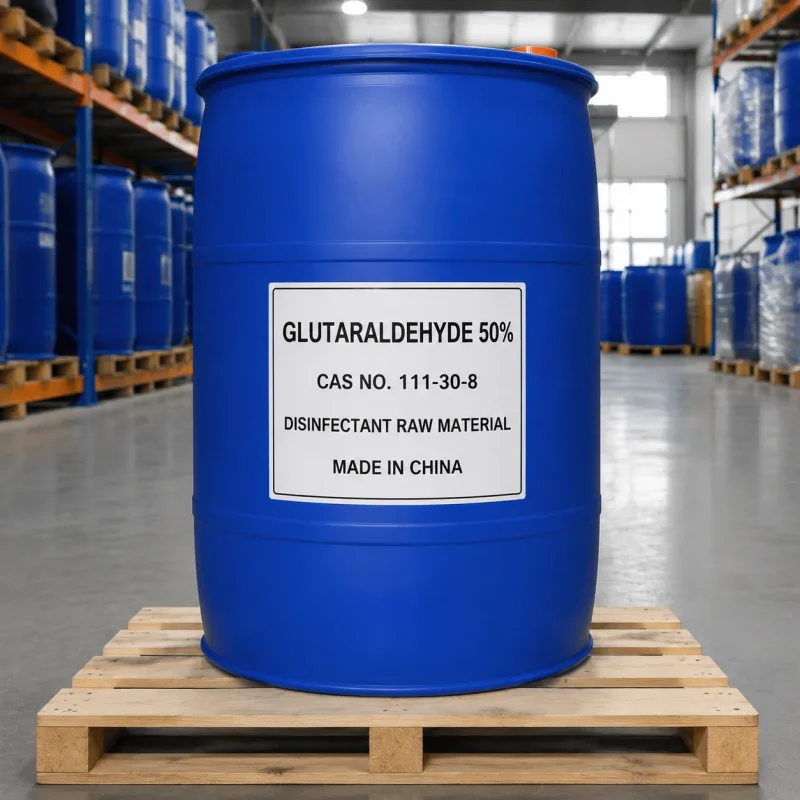
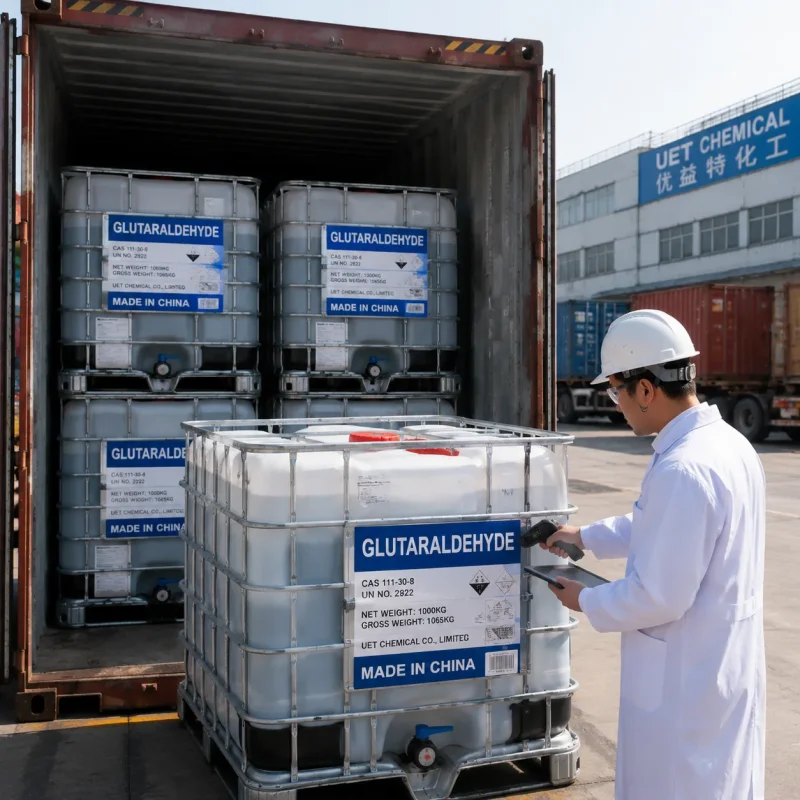
- Packaging: 220 kg (485 lb) HDPE drum / 1000 kg (2205 lb) IBC. Custom packaging available upon request.
- Main Applications: disinfectant, oilfield/water biocide, leather tanning, protein crosslinking
- pH: 3.0–5.0
- Specific gravity: 1.05–1.10 at 20 °C (68 °F)
Introduction to Glutaraldehyde
Glutaraldehyde is a colorless to pale-yellow aqueous dialdehyde solution containing two terminal aldehyde groups on a five-carbon chain. It kills microorganisms and crosslinks protein by reacting with lysine amino sites, so it is used mainly in medical device disinfectants and leather tanning.
Compared with formaldehyde, glutaraldehyde has much lower volatility; pure glutaraldehyde boils near 187 °C (369 °F), while formaldehyde boils at -19 °C (-2 °F), so dosing and bath control are easier. The main pitfall is alkaline activation and storage contamination: pH above 8 accelerates polymerization and consumes aldehyde, so active assay can drop and bath life shortens. Keep containers sealed, test aged lots before critical use, record daily pH/assay on batch cards, and retain sample bottles for audit files.
Key Features of Glutaraldehyde
- Dual aldehyde crosslinking: Two terminal –CHO groups react with amino sites in collagen or microbial proteins, forming bridges rather than simple surface precipitation.
- Low-volatility dosing: Neat glutaraldehyde boils around 187 °C (369 °F), so vapor loss in open tanks is lower than with formaldehyde-based alternatives.
- Broad biocide action: Oilfield and cooling-water programs typically use 10–300 mg/L active glutaraldehyde to control bacteria, algae and sulfate-reducing bacteria.
- Acid-side storage stability: Commercial 50% solution is held at pH 3.0–5.0, which slows oligomerization and keeps aldehyde assay stable before activation.
- Water-miscible handling: The aqueous solution dilutes directly into process water, so formulators do not need organic carriers for disinfectant or biocide concentrates.
Glutaraldehyde Chemical & Physical Properties
| Property | Value |
|---|---|
| Molecular Formula | C5H8O2 |
| Molecular Weight | 100.12 g/mol |
| Boiling Point | 187–189 °C (369–372 °F), neat material; 50% solution is water-rich |
| Density | 1.05–1.10 g/mL at 20 °C (8.8–9.2 lb/gal) |
| Flash Point | ≈71 °C (160 °F), closed cup, neat literature value; aqueous lot may be higher |
| Solubility | Miscible with water; soluble in alcohols |
| Vapor Pressure | ≈0.02 mmHg at 20 °C (68 °F) |
| Assay | 50.0 ±2.0% w/w typical 50% solution |
| pH | 3.0–5.0 |
Applications of Glutaraldehyde
Medical and device disinfection: Formulate at 2% w/v active glutaraldehyde (about 20 g/L or 2.7 oz/gal), then activate to pH 7.5–8.5. The dialdehyde reacts with microbial protein amino groups, supporting high-level disinfection in 20–45 min and longer sterilization cycles. Validate final product to EN 13727 or the relevant local method, not raw material alone.
Leather tanning: Apply 0.5–2.0% glutaraldehyde on shaved hide weight (0.5–2.0 lb per 100 lb). Aldehyde groups crosslink collagen lysine sites, raising wet-white shrinkage temperature and improving sweat/heat resistance. Check shrinkage by ISO 3380 and wash down free aldehyde before finishing.
Oilfield and cooling-water biocide: Dose 10–50 mg/L active for continuous treatment or 100–300 mg/L as a slug, depending on biomass. Glutaraldehyde attacks cell enzymes and biofilm proteins, helping control sulfate-reducing bacteria. Monitor by plate counts or ATP testing because organic matter consumes aldehyde.
Gelatin and protein crosslinking: Add 0.1–2.0% on protein solids for glues, gelatin films or abrasive binders. The two aldehyde ends bridge amino groups, reducing water solubility and increasing wet strength. Run small trials because over-crosslinking makes films brittle and raises residual odor.
Storage & Safety Precautions for Glutaraldehyde
Storage temperature: Store at 5–30 °C (41–86 °F); avoid freezing, hot warehouses, direct sun and sudden temperature swings.
Container control: Keep HDPE drums or IBCs tightly closed; after opening, reseal inner liners promptly to reduce water loss, dust ingress and contamination.
Incompatible materials: Separate glutaraldehyde from amines, ammonia, strong bases, strong oxidizers and reducing agents; alkaline contact lowers free aldehyde and accelerates polymerization.
Product-specific storage risk: Aged or alkaline-contaminated lots can darken and show lower active assay; retest pH and aldehyde value before critical disinfection or crosslinking use.
GHS classification: Commonly classified for acute toxicity, skin/eye corrosion or irritation, skin/respiratory sensitization and aquatic hazard; confirm lot-specific SDS Section 2.
PPE requirements: Use chemical goggles, face shield, nitrile or butyl gloves, chemical apron and, where ventilation is poor, organic-vapor/acid-gas respiratory protection.
Leak and spill handling: Stop the leak, contain with inert absorbent, then reduce residual aldehyde with sodium bisulfite where local procedure allows; do not wash glutaraldehyde into drains.
Transport classification: Typical 50% aqueous glutaraldehyde ships as UN 2922, Class 8, Packing Group III; diluted formulations may be Non-DG after SDS Section 14 review.
Operator detail: Rinse dosing lines with water after transfer; dried glutaraldehyde residue can crosslink and stick to valves, and any sticky film should trigger QA review.
Glutaraldehyde FAQ
Q: Is Glutaraldehyde CAS 111-30-8 supplied as pure material or aqueous solution?
A: It is normally sold as a 50% aqueous solution, not as 100% monomer. Glutaraldehyde monomer is reactive and tends to hydrate or oligomerize in water, so the commercial specification is active glutaraldehyde content, pH and color, not only molecular purity. For disinfectant or biocide use, choose 50% solution with assay 50 ±2% and pH 3–5. For leather or protein crosslinking, also request stabilizer/methanol and ash limits if the formulation is sensitive. In QC, hydroxylamine titration or chromatographic assay tracks aldehyde value; a drop in assay during storage usually signals oligomer formation. Ask for COA for each lot and retain a sample because color may darken with age. If the end use requires low residual methanol or low odor, state this before shipment because commercial grades vary.
Q: Why does 50% glutaraldehyde need pH control for disinfection?
A: Acidic pH keeps the solution stable; alkaline pH makes it more biocidal. Commercial 50% glutaraldehyde is usually pH 3–5 to limit polymerization and preserve assay. For high-level disinfection, formulators activate it to pH 7.5–8.5 with bicarbonate or proprietary activators, which increases reactive aldehyde species and improves kill of bacteria, mycobacteria and spores. The trade-off is bath life: activated solutions often lose activity within 7–14 days, depending on organic load and temperature. Monitor concentration with glutaraldehyde test strips or titration, and discard when active level falls below the validated minimum. Do not mix activators with strong oxidizers or amines. In practice, label activation date on the tank and verify pH before each shift; small pH shifts can change both efficacy and corrosivity.
Q: How does glutaraldehyde differ from formaldehyde in protein crosslinking?
A: Glutaraldehyde crosslinks proteins more efficiently and stays less volatile. Its five-carbon chain carries two aldehyde groups, so one molecule can bridge two lysine or hydroxylysine amino sites in collagen, gelatin or casein. Formaldehyde is smaller and more volatile, creating stronger vapor issues. In leather, glutaraldehyde at 0.5–2.0% on shaved weight raises wet-white shrinkage temperature and improves heat/sweat resistance, often checked by ISO 3380. It also gives softer, fuller leather than many formaldehyde resins. The drawback is residual aldehyde odor and sensitization risk. Wash or neutralize leather after tanning, and control free aldehyde in final articles, especially for footwear and glove leather. Request low-free-aldehyde specification if the article contacts skin; test by an accepted UV or titration method before shipment for records.
Related products
Manufacturer & Exporter Since 2006
Get Tailored Chemical Raw Material Solutions — Reply Within 1 Hour
Factory-direct pricing, stable high-purity supply and complete compliance documentation for your industrial formulations.
- 1000+Products
- 200+QC Protocols
- 7–15Days Delivery
- Factory-Direct Pricing
- COA / TDS / SDS Included
- Free Samples for Testing
- 40+ Export Countries
Request a Free Quote
Our engineers reply within 1 hour during GMT+8 business hours.
Please include in your inquiry:
- Product name or CAS number
- Required quantity
- Destination country or port
- Preferred packaging