
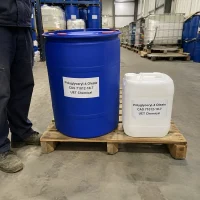
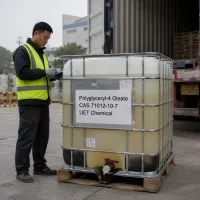
Polyglyceryl-4 Oleate CAS 71012-10-7
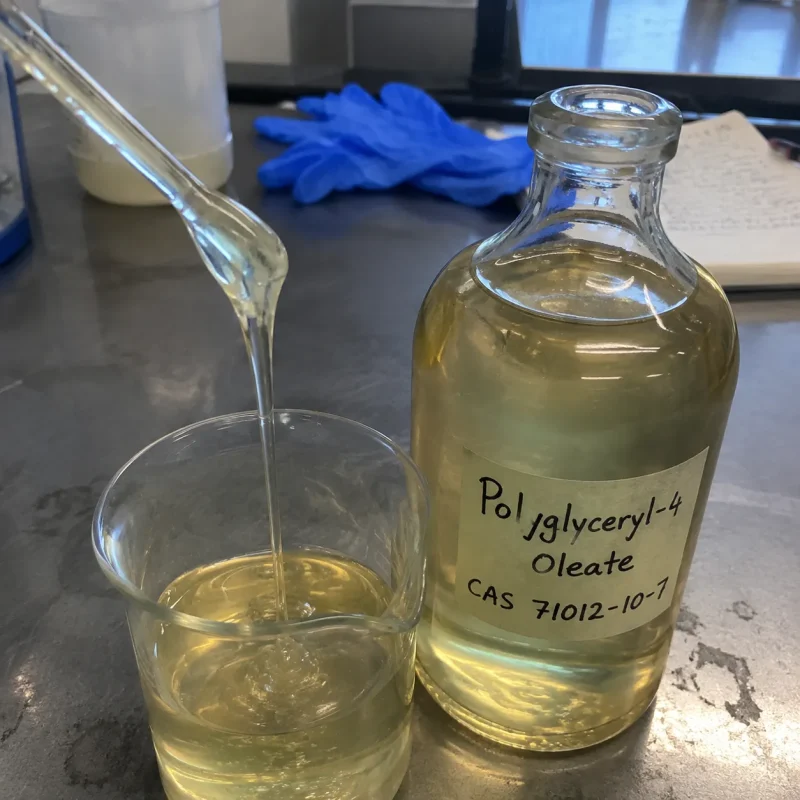
Polyglyceryl-4 Oleate is a non-ionic lipophilic emulsifier built from a tetraglycerol head esterified with oleic acid (C18:1). Supplied as a pale-yellow to amber viscous liquid (≥98% active), it functions as a primary W/O emulsifier and pigment dispersant in cold-process creams, cleansing oils, and mineral sunscreens. Zero ethoxylation ensures no 1,4-dioxane and full compliance with COSMOS and Ecocert standards. Each shipment includes COA, TDS, and SDS.
- CAS No.: 71012-10-7
- Synonyms: Polyglyceryl-4 Oleate; Tetraglyceryl Monooleate; PG-4 Oleate
- EINECS: 275-133-7
- Molecular Formula: C₃₀H₅₈O₈ (approximate)
- Molecular Weight: ~530 g/mol
- Appearance: Pale yellow to amber viscous liquid
- Acid Value: ≤5.0 mg KOH/g
- HLB Value: 5–6
- Hydroxyl Value: 280–320 mg KOH/g
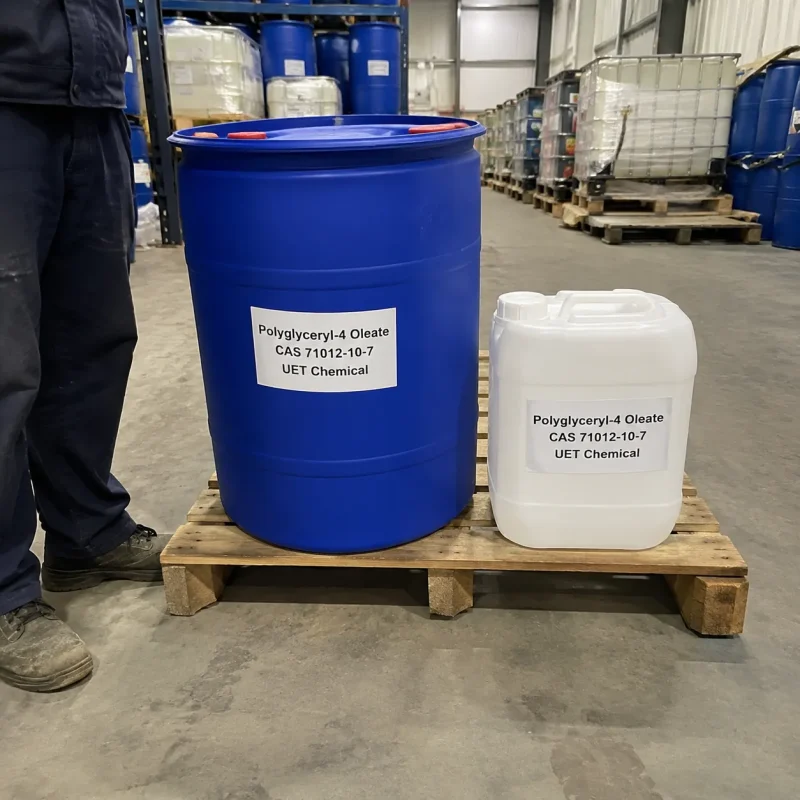
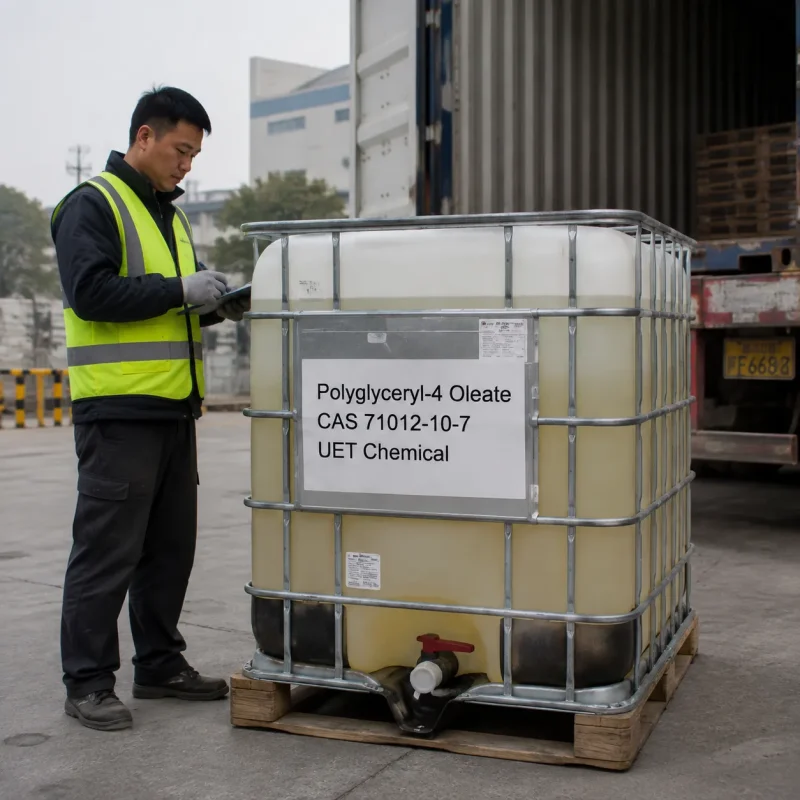
- Packaging: 25 kg HDPE drum / 200 kg HDPE drum. Custom packaging available upon request.
- Main Applications: W/O emulsions; cleansing oils; mineral sunscreen; pigment dispersion
Introduction to Polyglyceryl-4 Oleate
Polyglyceryl-4 Oleate is a pale-yellow to amber viscous liquid, a non-ionic lipophilic emulsifier formed by esterifying a tetraglycerol chain with oleic acid. The four-unit glycerol backbone provides multiple hydroxyl groups for strong interfacial anchoring, while the C18:1 oleoyl tail delivers excellent compatibility with triglycerides, esters, and silicone oils. Formulators rely on it as a primary W/O emulsifier, co-emulsifier, and inorganic pigment dispersant in cold-process creams, cleansing oils, and mineral sunscreens.
The tetraglycerol head creates a denser hydrogen-bond network at the oil-water interface than single-glycerol esters, stabilising W/O droplets against coalescence at concentrations as low as 1.5%. One practical caution: the oleic acid chain crystallises below 10 °C, causing cloudiness, graininess, or phase separation in finished products. Always store at 15–35 °C and incorporate 2–3% medium-chain triglycerides (MCT) into the oil phase to depress the crystallisation point and maintain clarity.
Key Features of Polyglyceryl-4 Oleate
- Zero-EO, COSMOS-compliant. Synthesised via direct esterification of polyglycerol and oleic acid. No ethylene oxide is used, eliminating 1,4-dioxane risk and satisfying COSMOS, Ecocert, and vegan formulation requirements.
- Strong interfacial anchoring. Four glycerol units provide eight free hydroxyl groups that form a dense hydrogen-bond network at the W/O interface, preventing droplet coalescence even under thermal cycling.
- Cold-process compatibility. The liquid state at room temperature and low melting range allow incorporation into oil phases at 25–40 °C, eliminating energy-intensive heating steps and protecting heat-sensitive actives.
- Excellent pigment wetting. The oleoyl tail adsorbs onto hydrophobic ZnO and TiO₂ surfaces, reducing agglomeration and improving SPF uniformity in mineral sunscreens without requiring additional coating agents.
Polyglyceryl-4 Oleate Chemical & Physical Properties
| Property | Value |
|---|---|
| Molecular Formula | C₃₀H₅₈O₈ (approximate) |
| Molecular Weight | ~530 g/mol |
| Appearance | Pale yellow to amber viscous liquid |
| Acid Value | ≤5.0 mg KOH/g |
| Hydroxyl Value | 280–320 mg KOH/g |
| HLB Value | 5–6 |
| Water Content | ≤1.0% (Karl Fischer) |
| Saponification Value | 150–170 mg KOH/g |
| Solubility | Dispersible in water; soluble in oils, esters, silicones |
Applications of Polyglyceryl-4 Oleate
W/O cold-process creams and lotions: Used at 2–5% of the oil phase. The tetraglycerol head anchors at the oil-water interface while the oleoyl tail extends into the continuous oil phase, forming stable W/O droplets at 1–10 µm without heating above 40 °C.
Cleansing oils and makeup removers: Dosed at 5–15%. The lipophilic tail dissolves long-wear pigments and silicone-based foundations, while the glycerol head allows rapid rinse-off with water, leaving no greasy residue.
Mineral sunscreens and BB creams: Added at 1–3% relative to pigment load. The oleoyl chain wets ZnO and TiO₂ particle surfaces, reducing agglomerates below 5 µm and improving SPF homogeneity across application areas.
Food-grade emulsions and bakery release agents: Incorporated at 0.5–2% in edible oil blends. Provides uniform fat distribution in dough and prevents sticking on baking surfaces without introducing synthetic emulsifiers.
Storage & Safety Precautions for Polyglyceryl-4 Oleate
Storage conditions. Store in sealed HDPE drums at 15–35 °C, away from direct sunlight and moisture. Below 10 °C the oleic acid chain crystallises, causing the liquid to turn cloudy or form a waxy sediment. If crystallisation occurs, warm the drum to 40–45 °C and stir gently until fully homogeneous. Do not exceed 60 °C to avoid oxidative yellowing of the unsaturated C18:1 bond.
Safety and PPE. GHS: Not classified as hazardous. Non-irritating to skin and eyes at cosmetic concentrations. Wear standard nitrile gloves and safety glasses during drum transfers to maintain hygiene. Spills are non-toxic but slippery; contain with inert absorbent and wash with warm soapy water.
Transport classification. Non-DG. Not regulated under IMDG, IATA, or ADR. Ship as standard general cargo. Ensure drum bungs are sealed with PE-lined caps to prevent moisture ingress during ocean freight.
Practitioner note: When formulating a mineral sunscreen, pre-disperse Polyglyceryl-4 Oleate with the ZnO/TiO₂ powder before adding the remaining oil phase. Direct addition to a pre-mixed oil blend results in poor pigment wetting and visible white streaks. Use a high-shear mixer at 3000–5000 rpm for 10–15 minutes to achieve a uniform grind.
Polyglyceryl-4 Oleate FAQ
Q: How do I prevent crystallisation in Polyglyceryl-4 Oleate (CAS 71012-10-7) during winter storage?
A: The oleic acid chain crystallises below 10 °C. Store drums at 15–35 °C. If crystallisation occurs, warm the drum to 40–45 °C in a water bath and stir until clear. For finished formulations, add 2–3% medium-chain triglycerides (MCT) to the oil phase. MCT depresses the crystallisation point by 5–8 °C, maintaining product clarity and texture during cold-chain transport.
Q: What is the optimal HLB balance when pairing Polyglyceryl-4 Oleate with a hydrophilic co-emulsifier?
A: Polyglyceryl-4 Oleate has an HLB of 5–6. For stable W/O emulsions, target a composite HLB of 4–7. Pair it with a hydrophilic co-emulsifier (HLB 8–12) at a 70:30 to 60:40 ratio. For O/W systems, invert the ratio. Always run a 48-hour centrifuge test at 3000 rpm and a 30-day stability test at 45 °C to confirm droplet integrity.
Q: Can it replace PEG-based emulsifiers in “clean beauty” formulations?
A: Yes. Polyglyceryl-4 Oleate is synthesised via direct esterification without ethylene oxide, resulting in zero 1,4-dioxane and zero PEG residues. It meets COSMOS, Ecocert, and EWG verified criteria. The tetraglycerol head provides equivalent emulsification efficiency to PEG-4 esters at the same use level, with superior biodegradation (OECD 301B >70% in 28 days).
Related products
Manufacturer & Exporter Since 2006
Get Tailored Chemical Raw Material Solutions — Reply Within 1 Hour
Factory-direct pricing, stable high-purity supply and complete compliance documentation for your industrial formulations.
- 1000+Products
- 200+QC Protocols
- 7–15Days Delivery
- Factory-Direct Pricing
- COA / TDS / SDS Included
- Free Samples for Testing
- 40+ Export Countries
Request a Free Quote
Our engineers reply within 1 hour during GMT+8 business hours.
Please include in your inquiry:
- Product name or CAS number
- Required quantity
- Destination country or port
- Preferred packaging