
Poly Ferric Sulfate CAS 35139-28-7
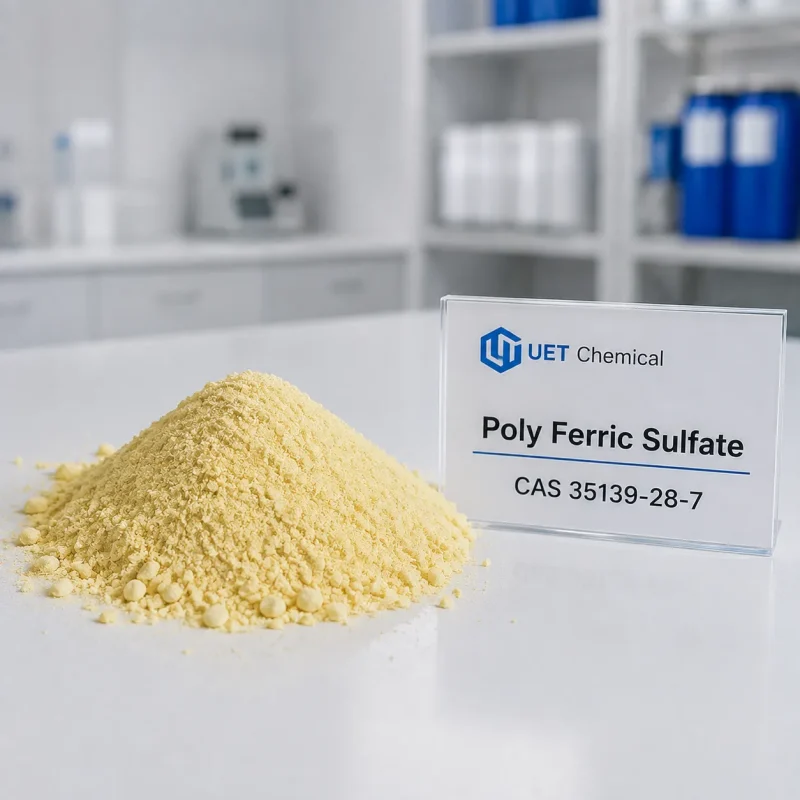
Poly Ferric Sulfate (PFS) is a pre-hydrolyzed iron(III) coagulant with the general formula [Fe₂(OH)ₙ(SO₄)₃₋ₙ/₂]ₘ, supplied as pale-yellow powder or reddish-brown liquid. Polynuclear hydroxy-Fe(III) species carry high charge density, destabilising colloids and bridging dense flocs in municipal and industrial wastewater treatment. PFS performs across pH 4–11 and forms fast-settling flocs even at 5 °C raw-water temperature. Each shipment includes COA, TDS, and SDS.
- CAS No.: 35139-28-7
- Synonyms: Polyferric sulfate; PFS; Basic ferric sulfate
- EINECS: 252-514-5
- Molecular Formula: [Fe₂(OH)ₙ(SO₄)₃₋ₙ/₂]ₘ
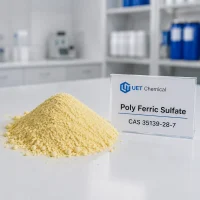
- Appearance: Pale-yellow amorphous powder (solid); reddish-brown liquid
- Total Iron (solid): ≥21%
- Basicity: 8–16%
- pH (1% aq.): 2.0–3.0
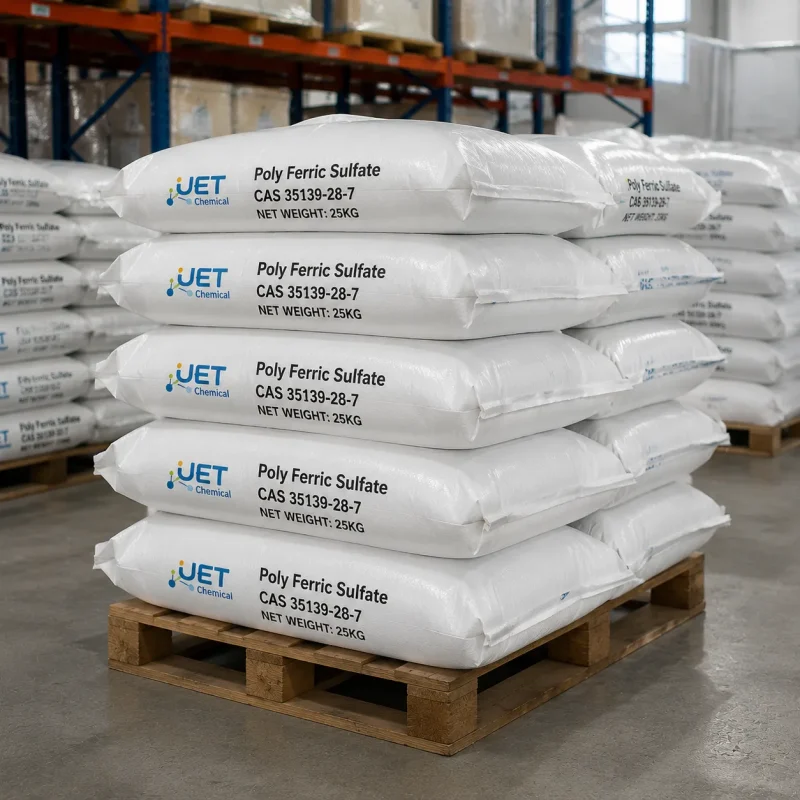
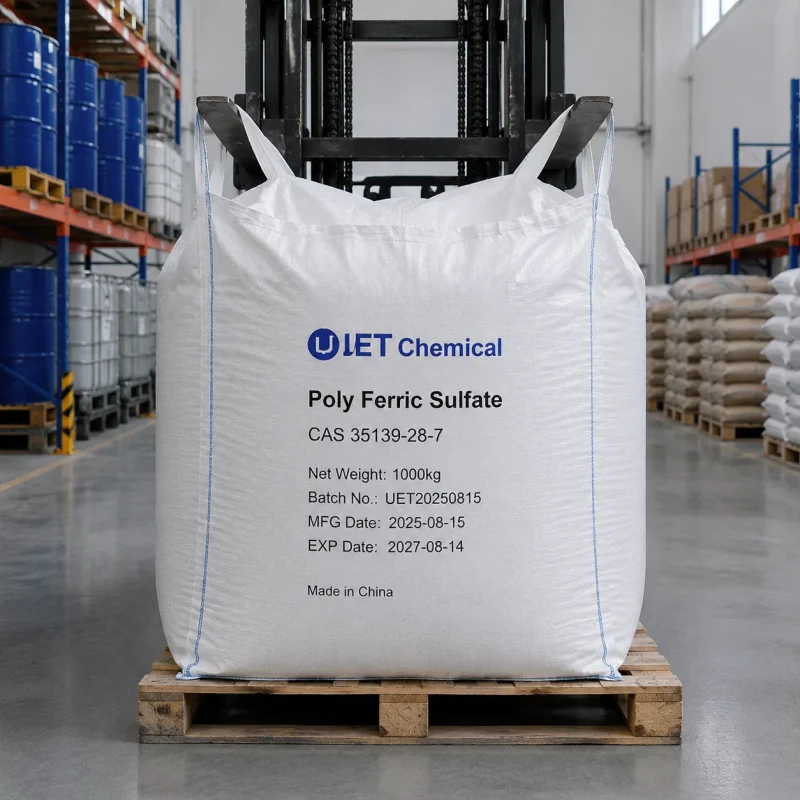
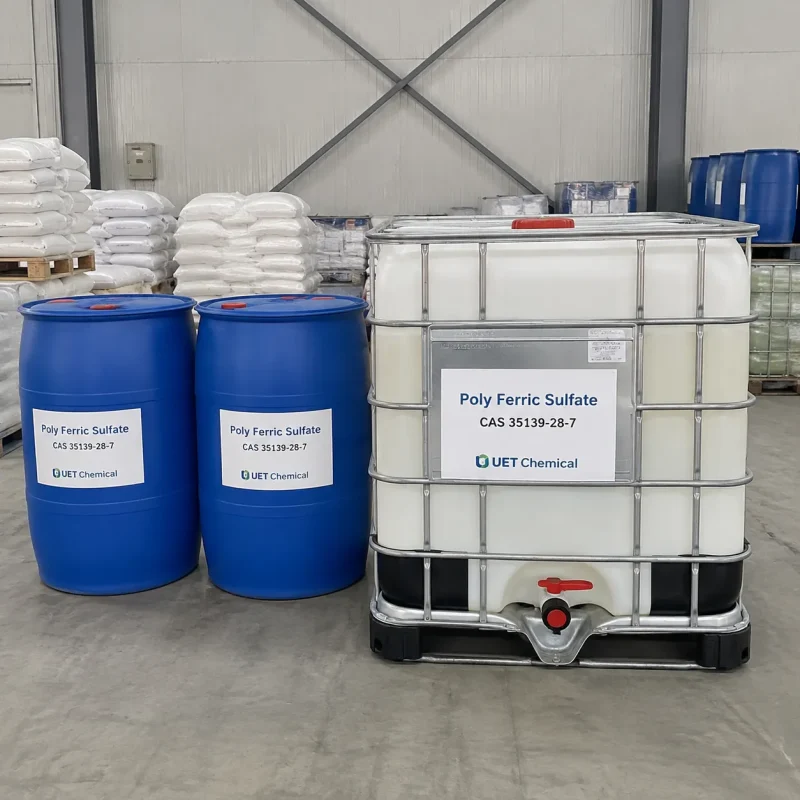
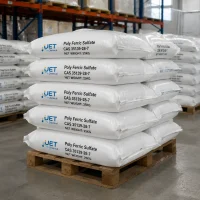
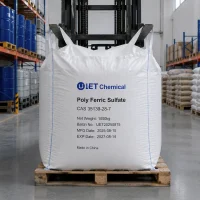
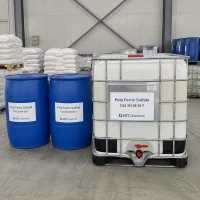
- Packaging: 25 kg woven bag / 1000 kg FIBC (solid); 1000 L IBC tote (liquid). Custom packaging available upon request.
- Main Applications: Drinking water clarification; municipal wastewater; industrial effluent; sludge dewatering
Introduction to Poly Ferric Sulfate
Poly Ferric Sulfate is supplied as a pale-yellow amorphous powder or a reddish-brown liquid, an inorganic pre-polymerised iron(III) coagulant built from polynuclear hydroxy complexes [Fe₂(OH)ₙ(SO₄)₃₋ₙ/₂]ₘ. The pre-formed Fe(III)-hydroxo species carry a higher positive charge per iron atom than simple ferric sulfate. Plants use it to clarify drinking water, treat municipal sewage, and polish dyeing, electroplating, and coal-washing effluents.
Because polymerisation happens in the reactor rather than in the dosing tank, PFS consumes less alkalinity and builds flocs 2–3× denser than simple iron salts, cutting settling time by 30–50% at raw-water temperatures down to 5 °C. One practical caution: the liquid grade is strongly acidic (pH 2–3) and attacks carbon steel; dose from FRP, PP, or PE-lined tanks with EPDM-diaphragm pumps, and never share a line with alkaline streams—premature neutralisation precipitates Fe(OH)₃ and blocks injection quills.
Key Features of Poly Ferric Sulfate
- High charge density, pre-hydrolysed. Polynuclear [Fe₂(OH)₄]⁴⁺-type species neutralise negative colloidal charge on contact; floc formation begins within seconds of dosing, with no waiting for in-situ hydrolysis.
- Wide pH and temperature window. Effective from pH 4 to 11 without alkaline correction, and floc density holds at 5 °C raw water where simple salts slow down.
- Phosphorus and colour removal. Fe(III) precipitates phosphate as insoluble FePO₄, driving total phosphorus below 0.5 mg/L; charge neutralisation collapses dye colloids, cutting colour 60–90% in dyeing effluent.
- Dense, fast-settling flocs. Bridged flocs reach 2–3× the density of alum flocs, cutting clarifier retention time 30–50% and raising sludge cake solids by 2–5 percentage points.
- Low residual iron at correct dose. Jar-test-optimised dosing keeps effluent iron below 0.3 mg/L, avoiding the yellow tint that overdosed simple iron salts leave in treated water.
Poly Ferric Sulfate Chemical & Physical Properties
| Property | Value |
|---|---|
| Molecular Formula | [Fe₂(OH)ₙ(SO₄)₃₋ₙ/₂]ₘ (n < 1) |
| Total Iron (solid / liquid) | ≥21% / ≥11% |
| Basicity | 8–16% |
| pH (1% aq. solution) | 2.0–3.0 |
| Density (liquid, 20 °C) | ≥1.45 g/cm³ |
| Water-Insoluble Matter | ≤0.5% |
| Ferrous Iron (Fe²⁺) | ≤0.5% |
| Arsenic / Lead | ≤5 ppm / ≤15 ppm |
| Production Standard | GB 14591-2016 |
Applications of Poly Ferric Sulfate
Drinking water clarification: Dosed at 5–30 mg/L as product. Polynuclear Fe(III) species neutralise turbidity colloids and sweep fine particles into dense flocs; residual turbidity below 1 NTU after settling. Jar-test each raw-water source before fixing the dose.
Municipal wastewater treatment: Used at 30–100 mg/L at the primary or secondary clarifier. Charge neutralisation plus FePO₄ precipitation holds total phosphorus below 0.5 mg/L and cuts COD 30–60% ahead of biological stages.
Industrial effluent (dyeing, electroplating, leather): Dosed at 100–500 mg/L. Hydroxide floc sweep co-precipitates heavy metals (Cu²⁺, Ni²⁺, Cr³⁺) while charge neutralisation collapses dye colloids, removing 60–90% of colour in a single stage.
Sludge conditioning and dewatering: Added at 2–8 kg per tonne of dry solids before the belt press. PFS re-flocs fine solids and releases bound water, raising cake dry solids by 2–5 percentage points and cutting filtrate turbidity.
Storage & Safety Precautions for Poly Ferric Sulfate
Storage conditions. Solid: keep bags sealed at 5–35 °C in a dry warehouse; PFS powder is hygroscopic and cakes above 65% RH—caked material still dissolves normally after crushing. Liquid: store only in FRP, PP, or PE-lined tanks; carbon steel corrodes at pH 2–3 within weeks. Keep both forms away from alkalis and cyanide salts—acid contact releases toxic fumes.
Safety and PPE. GHS (solid): Eye Irrit. 2 (H319). Liquid: Skin Corr. 1C (H314). Wear an N95 dust mask, chemical-splash goggles, and acid-resistant gloves during bag emptying or pump maintenance. Spills: solid—sweep up dry; liquid—contain and neutralise with soda ash before washing.
Transport classification. Solid: Non-DG, not regulated under IMDG, IATA, or ADR. Liquid: verify with the carrier—acidic grades are commonly assessed as Class 8, UN 3264, PG III.
Practitioner note: Prepare dosing solutions at 5–10% and use within 48 h; longer standing continues polymerisation and deposits basic salts on tank walls. When pairing with anionic PAM, inject PFS first, rapid-mix 20–30 s, then add PAM at slow mix—simultaneous dosing at one point restabilises the colloid and produces weak, sheared flocs.
Poly Ferric Sulfate FAQ
Q: How do I determine the correct dose of Poly Ferric Sulfate (CAS 35139-28-7) for my plant?
A: Run a jar test: 2 min rapid mix at 150 rpm, 15 min slow mix at 30 rpm, 10 min settle. Test 5–500 mg/L in steps matched to your water. Pick the knee point where residual turbidity or TP stops falling, then confirm residual iron stays below 0.3 mg/L—dosing past the knee wastes chemical and tints the effluent yellow.
Q: My PFS powder caked into a hard block after two months. Is it still usable?
A: Yes. Caking is physical moisture uptake, not chemical degradation. Crush the block and check total iron and basicity on the COA method; values within spec mean full coagulation activity. Dissolve as usual—the cake may need 10–15 min extra agitation. Store future bags on pallets with warehouse RH below 60% and reseal opened bags.
Q: Can I dose PFS and anionic polyacrylamide at the same injection point?
A: No. Simultaneous dosing lets the anionic polymer wrap the iron colloid before charge neutralisation finishes, restabilising particles and producing weak, sheared flocs. Inject PFS first with 20–30 s rapid mix, then add PAM at a second point under slow mixing (30 rpm). Spacing the two by one hydraulic stage typically cuts total chemical cost 10–20%.
Related products
Manufacturer & Exporter Since 2006
Get Tailored Chemical Raw Material Solutions — Reply Within 1 Hour
Factory-direct pricing, stable high-purity supply and complete compliance documentation for your industrial formulations.
- 1000+Products
- 200+QC Protocols
- 7–15Days Delivery
- Factory-Direct Pricing
- COA / TDS / SDS Included
- Free Samples for Testing
- 40+ Export Countries
Request a Free Quote
Our engineers reply within 1 hour during GMT+8 business hours.
Please include in your inquiry:
- Product name or CAS number
- Required quantity
- Destination country or port
- Preferred packaging