
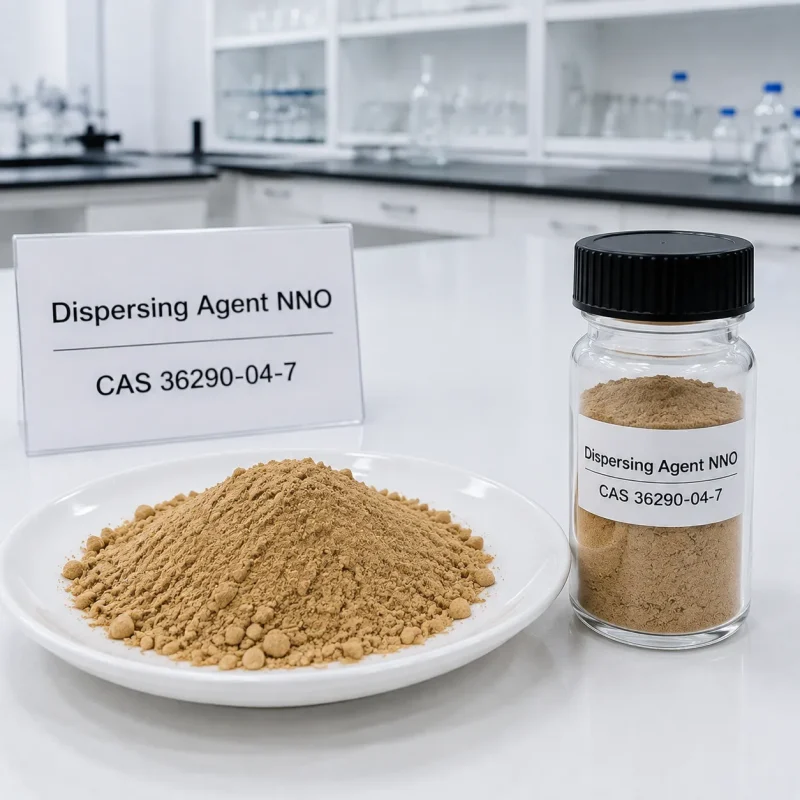

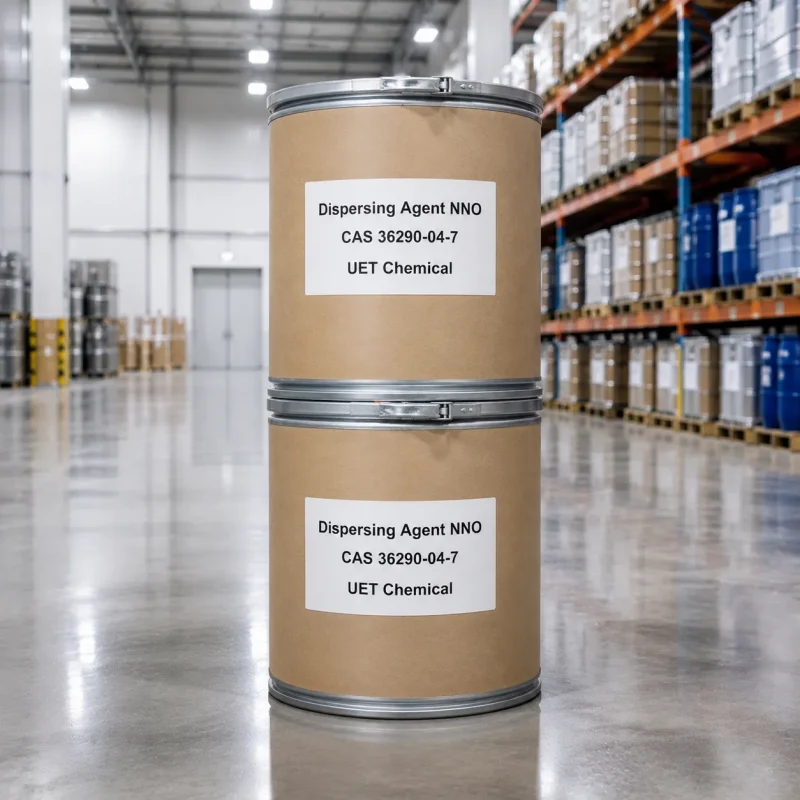

Dispersing Agent NNO CAS 36290-04-7
Dispersing Agent NNO is an anionic polymeric surfactant built on a naphthalene sulfonate formaldehyde condensate backbone. Supplied as a free-flowing yellowish powder, it solves particle agglomeration and sedimentation challenges in aqueous systems. Industrial formulators rely on NNO for textile dye dispersion, pesticide wettable powders (WP), and concrete flow modification. UETChem supplies this product with strict control over sulfonation degree and moisture content to guarantee rapid dissolution and long-term suspension stability. Each shipment includes COA, TDS, SDS.
- CAS No: 36290-04-7
- Synonyms: NNO; Sodium naphthalene sulfonate formaldehyde condensate; Diffragent NNO
- EINECS: 252-952-3
- Molecular Formula: (C11H8O3SNa)n
- Molecular Weight: 400 – 600 g/mol (average)
- Appearance: Light yellow to brownish powder
- pH (1% aqueous): 7.0 – 9.0
- Insolubles: 0.1% max
- Packaging: 25 kg (55 lb) bag, 500 kg (1102 lb) pallet. Custom packaging available upon request.
- Main Applications: Disperse dye carrier, agrochemical WP dispersant, concrete superplasticizer base, latex stabilizer
Introduction to Dispersing Agent NNO
Dispersing Agent NNO is an anionic polymeric surfactant composed of naphthalene sulfonate formaldehyde condensate sodium salt. The molecular structure consists of a hydrophobic naphthalene backbone with multiple hydrophilic sulfonate (-SO3Na) groups attached. This architecture allows the molecule to adsorb onto solid particle surfaces in aqueous systems.
Chemical manufacturers utilize NNO to suspend hydrophobic pigments, active agrochemical ingredients, and cement particles. The material dissolves rapidly in water to form a clear to slightly hazy alkaline solution. It remains stable across a wide pH range and maintains dispersion integrity in hard water environments without precipitating calcium or magnesium salts.
Key Features of NNO
- Electrostatic repulsion: The dense sulfonate groups impart a strong negative zeta potential to dispersed particles, preventing agglomeration through charge repulsion.
- Hard water tolerance: The sulfonate head groups resist binding with calcium and magnesium ions, ensuring consistent dispersion performance in untreated industrial water.
- Thermal stability: The naphthalene-formaldehyde backbone withstands high-temperature dyeing processes up to 130 °C (266 °F) without degrading or losing dispersing power.
- Acid/Alkali resistance: Maintains structural integrity and surface activity in highly acidic pesticide formulations and alkaline concrete mixes.
NNO Chemical & Physical Properties
| Property | Value |
|---|---|
| Molecular Formula | (C11H8O3SNa)n |
| Appearance | Light yellow to brownish powder |
| pH (1% solution) | 7.0 – 9.0 |
| Solubility | Highly soluble in water; insoluble in organic solvents |
| Insoluble Matter | 0.1% max |
| Moisture Content | 3.0% max |
| Bulk Density | 0.6 – 0.8 g/cm³ |
Applications of NNO
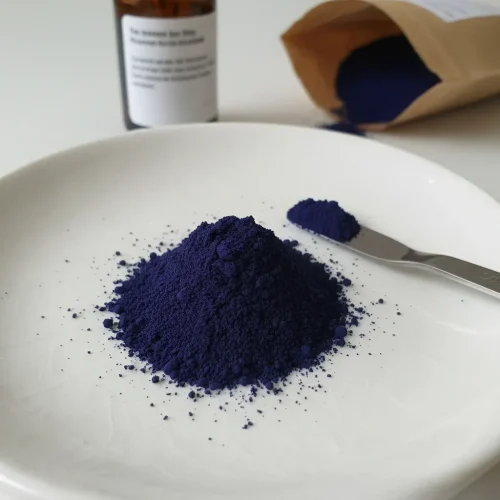
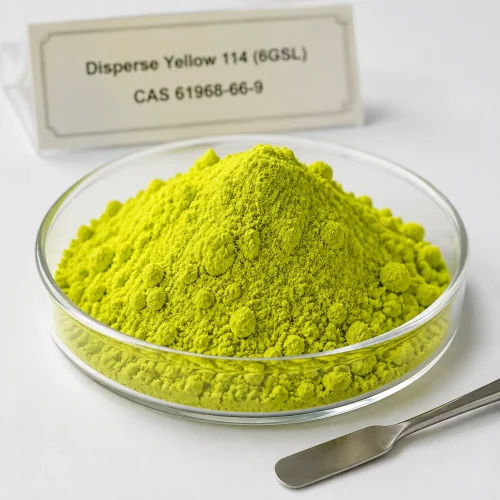
Textile dye dispersant: Used at 2-5% loading in disperse and vat dye formulations. The NNO molecules wrap around dye crystals, preventing aggregation during high-temperature high-pressure (HTHP) dyeing. Formulators often test NNO dispersion efficiency using pigments like Phthalocyanine Blue Pigment to ensure uniform fabric coloration.
Agrochemical Wettable Powders (WP): Dosed at 3-8% in pesticide WP formulations. NNO reduces the surface tension of the spray liquid and keeps active ingredients like Metarhizium Anisopliae Powder uniformly suspended in the spray tank, preventing nozzle clogging.
Concrete superplasticizer base: Blended with naphthalene-based water reducers. Formulators often combine NNO with SNF Naphthalene Superplasticizer to optimize cement dispersion, improve flowability, and release trapped water in high-strength concrete mixes.
Storage & Safety Precautions for NNO
- Moisture control: NNO powder is hygroscopic. Store bags on pallets in a dry warehouse below 35 °C (95 °F). Moisture ingress causes the powder to cake into hard blocks that require milling before use.
- Dust and handling: The fine powder can cause respiratory irritation. Wear N95 masks and goggles during bag slitting. Sweep dry spills immediately to prevent slip hazards when wet.
- Field note: When preparing a 10% stock solution, add NNO powder to warm water (40 °C / 104 °F) under moderate agitation. Dumping it into cold, stagnant water creates sticky lumps that take hours to dissolve.
NNO FAQ
Q: Why does Dispersing Agent NNO clump in my warehouse?
A: NNO powder is highly hygroscopic and absorbs ambient moisture, causing particles to fuse into hard blocks. Store Dispersing Agent NNO on pallets in a dry warehouse below 35 °C (95 °F) and keep bags tightly sealed after opening to maintain free-flowing powder.
Q: How does NNO improve pesticide spray tank mixing?
A: Dispersing Agent NNO adsorbs onto hydrophobic active ingredients, imparting a strong negative charge that prevents particle agglomeration. Dosing NNO at 3-8% in Wettable Powder (WP) formulations keeps the pesticide uniformly suspended in the spray tank and prevents nozzle clogging.
Q: Can NNO withstand high-temperature dyeing?
A: Yes, the naphthalene-formaldehyde backbone of Dispersing Agent NNO provides excellent thermal stability. It maintains its dispersing power and prevents dye aggregation during high-temperature high-pressure (HTHP) polyester dyeing processes up to 130 °C (266 °F).
Related products
Manufacturer & Exporter Since 2006
Get Tailored Chemical Raw Material Solutions — Reply Within 1 Hour
Factory-direct pricing, stable high-purity supply and complete compliance documentation for your industrial formulations.
- 1000+Products
- 200+QC Protocols
- 7–15Days Delivery
- Factory-Direct Pricing
- COA / TDS / SDS Included
- Free Samples for Testing
- 40+ Export Countries
Request a Free Quote
Our engineers reply within 1 hour during GMT+8 business hours.
Please include in your inquiry:
- Product name or CAS number
- Required quantity
- Destination country or port
- Preferred packaging