
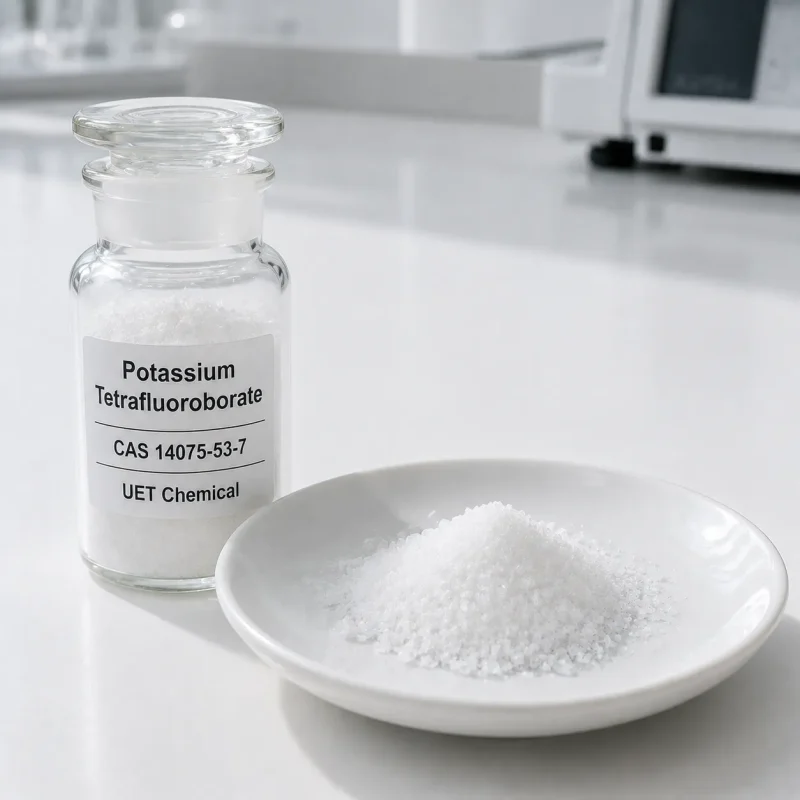
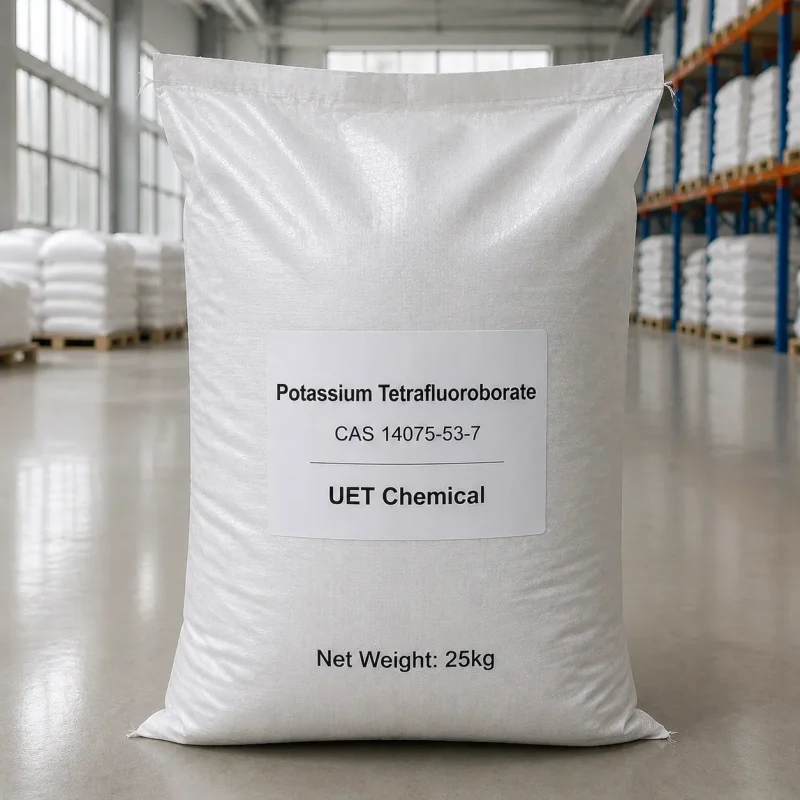
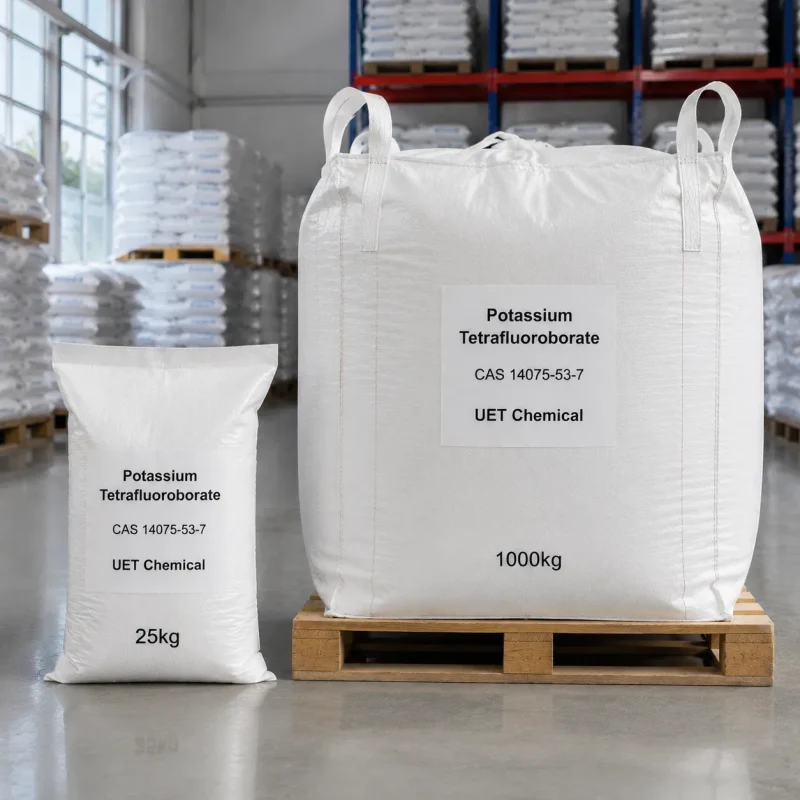
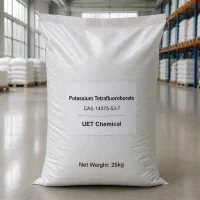
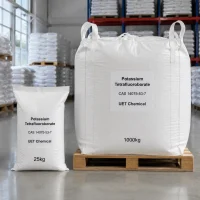
Potassium Tetrafluoroborate CAS 14075-53-7
Potassium Tetrafluoroborate (KBF4) is an inorganic fluoroborate salt featuring a stable tetrahedral BF4⁻ anion, supplied as a white crystalline powder. It delivers active boron and fluorine at high temperatures, serving as a primary grain-refining flux in aluminum smelting and a conducting salt in electroplating baths. UETChem also supplies this product with strict control over moisture and free acid to prevent hydrolysis during ocean freight. Each shipment includes COA, TDS, SDS.
- CAS No: 14075-53-7
- Synonyms: KBF4; Potassium fluoroborate
- EINECS: 237-928-2
- Molecular Formula: KBF4
- Molecular Weight: 125.90 g/mol (125.90 lb/lbmol)
- Appearance: White crystalline powder
- Purity: 98.0% min
- Moisture: 0.5% max
- Free Acid (as HF): 0.1% max
- Iron (Fe): 50 ppm max
- Packaging: 25 kg (55 lb) bag, 200 kg (441 lb) drum. Custom packaging available upon request.
- Main Applications: Aluminum alloy flux, electroplating electrolyte, boronizing agent
Introduction to KBF4
KBF4 is a white crystalline inorganic salt built around a tetrahedral BF4⁻ anion. It supplies active boron and fluorine when heated above 500 °C (932 °F). Aluminum foundries and electroplating shops use it to refine grain structure and boost bath conductivity.
The main advantage over simple fluorides is delayed release; the B-F bonds break down exactly at molten metal temperatures. Moisture is the real enemy here. Wet KBF4 hydrolyzes to form hydrofluoric acid (HF), which eats through carbon steel drums and ruins plating baths. Always check the free acid spec before loading the furnace.
Key Features of KBF4
- Tetrahedral BF4⁻ structure: Delivers controlled boron release without premature volatilization at room temperature.
- High thermal stability: Remains intact up to 530 °C (986 °F), activating only when the metal bath reaches casting temperature.
- Low moisture limit: Keeping water below 0.5% stops HF generation and prevents powder caking in the warehouse.
- Oxide wetting action: Fluorine release lowers surface tension in molten aluminum, pulling alumina into the dross layer.
KBF4 Chemical & Physical Properties
| Property | Value |
|---|---|
| Molecular Formula | KBF4 |
| Molecular Weight | 125.90 g/mol (125.90 lb/lbmol) |
| Melting Point | ~530 °C (986 °F) with decomposition |
| Density | 2.50 g/cm³ (20.8 lb/gal) at 20 °C (68 °F) |
| Solubility | Slightly soluble in water (4.4 g/L at 68 °F); insoluble in organics |
| pH (10g/L aqueous) | 3.5–5.0 |
| Free Acid (as HF) | 0.1% max |
Applications of KBF4
Aluminum refining flux: Added at 0.1–0.5% by weight to molten baths. The BF4⁻ anion breaks down to release fluorine, reacting with alumina to form fluid slag. This traps impurities and refines the alpha-aluminum grain structure.
Electroplating electrolyte: Acts as a conducting salt in tin and zinc baths at 20–80 g/L. For tin-specific baths, operators often pair it with Tin (2+) Oxalate to improve throwing power and deposit brightness.
Steel boronizing agent: Mixed with inert carriers at 800–950 °C (1472–1742 °F). Active boron atoms diffuse into the steel surface, forming a hard iron boride (Fe2B) layer for wear resistance. For other boron sources, manufacturers often cross-reference Sodium Tetraborate Decahydrate.
Storage & Safety Precautions for KBF4
- Moisture and hydrolysis control: Store bags tightly sealed below 35 °C (95 °F). Absorbed water triggers hydrolysis, releasing trace HF and dropping the pH. Keep the warehouse dry; facilities often run Calcium Chloride Anhydrous in adjacent drying rooms to control ambient humidity.
- Thermal decomposition risk: Decomposes above 530 °C to release toxic boron trifluoride (BF3) gas. Keep away from open flames. Sweep dry spills with a brush; never use wet mops, as water accelerates acid generation.
- Handling and PPE: Treat as a corrosive irritant. Wear dust masks, goggles, and rubber gloves during powder transfer to avoid inhaling fine particulates or contacting trace HF.
- Field note: When charging KBF4 into an aluminum smelting furnace, inject it beneath the melt surface. Throwing cold powder onto molten metal causes steam explosions if the bags absorbed transit moisture.
KBF4 FAQ
Q: Why does KBF4 clump in humid storage?
A: KBF4 absorbs moisture, triggering BF4⁻ hydrolysis. This releases trace HF, causing the powder to cake and drop in pH. Store in sealed, dry conditions below 35 °C (95 °F) and retest free acid if clumping occurs before use.
Q: How does Potassium Tetrafluoroborate refine aluminum grains?
A: At 700–750 °C, Potassium Tetrafluoroborate releases active fluorine and boron. Fluorine wets alumina inclusions, pulling them into the dross. Trace boron acts as a nucleation site for finer alpha-aluminum grains during solidification.
Q: Is KBF4 safe for tin electroplating baths?
A: Yes, at 20–80 g/L KBF4 acts as a stable conducting salt. Ensure free acid (HF) stays below 0.1% to prevent anode corrosion. Filter the bath regularly to remove undissolved particulates and maintain throwing power.
Related products
Manufacturer & Exporter Since 2006
Get Tailored Chemical Raw Material Solutions — Reply Within 1 Hour
Factory-direct pricing, stable high-purity supply and complete compliance documentation for your industrial formulations.
- 1000+Products
- 200+QC Protocols
- 7–15Days Delivery
- Factory-Direct Pricing
- COA / TDS / SDS Included
- Free Samples for Testing
- 40+ Export Countries
Request a Free Quote
Our engineers reply within 1 hour during GMT+8 business hours.
Please include in your inquiry:
- Product name or CAS number
- Required quantity
- Destination country or port
- Preferred packaging