
Glacial Acrylic Acid (GAA) CAS 79-10-7
Glacial Acrylic Acid (GAA) is an unsaturated organic carboxylic acid featuring both a reactive vinyl group and a carboxyl group on a three-carbon chain. Supplied as a clear liquid with 200 ppm MEHQ inhibitor, it solves monomer synthesis and polymer crosslinking challenges. Chemical plants rely on GAA for superabsorbent polymers (SAP), acrylic esters, and UV-curable resins. UETChem supplies this product with strict control over purity, moisture, and inhibitor distribution to guarantee safe transit and high reaction yields. Each shipment includes COA, TDS, SDS.
- CAS No: 79-10-7
- Synonyms: GAA; 2-Propenoic acid; Vinylformic acid
- EINECS: 201-177-9
- Molecular Formula: C3H4O2
- Molecular Weight: 72.06 g/mol (72.06 lb/lbmol)
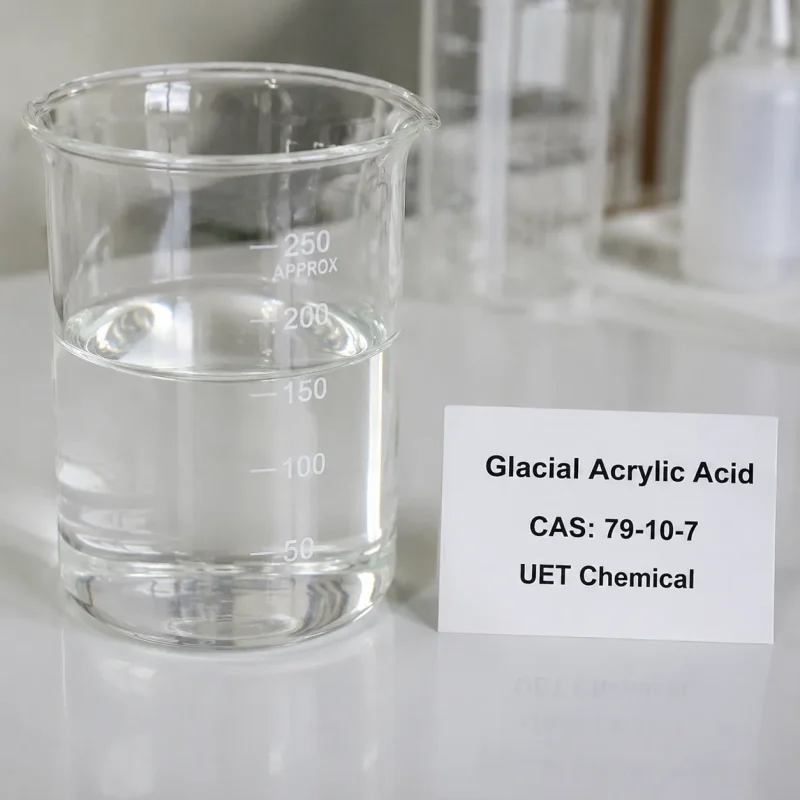
- Appearance: Colorless transparent liquid
- Purity: 99.0% min
- Inhibitor (MEHQ): 190 – 210 ppm
- Moisture: 0.10% max
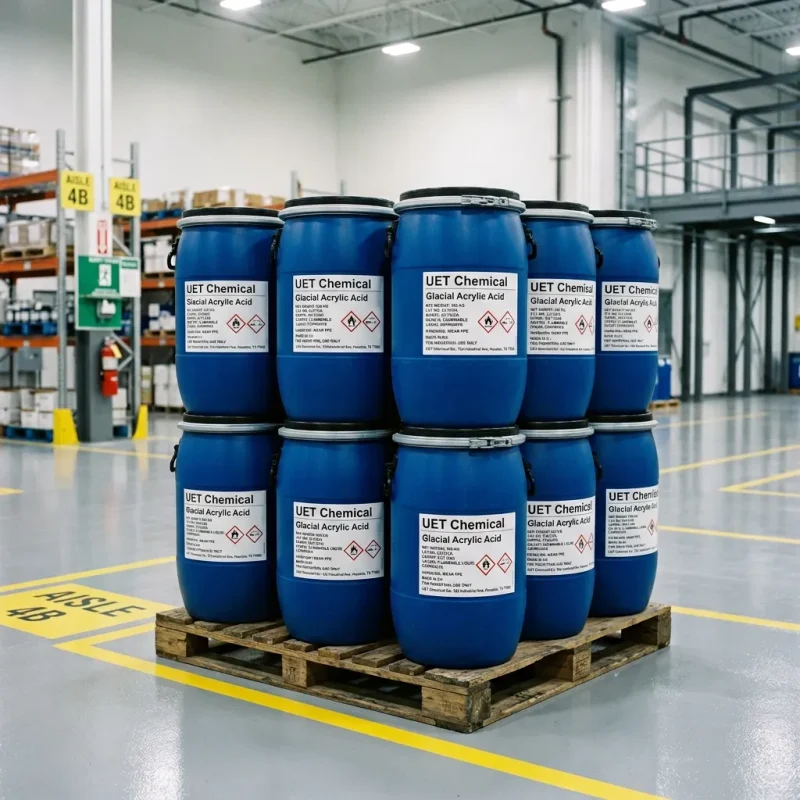
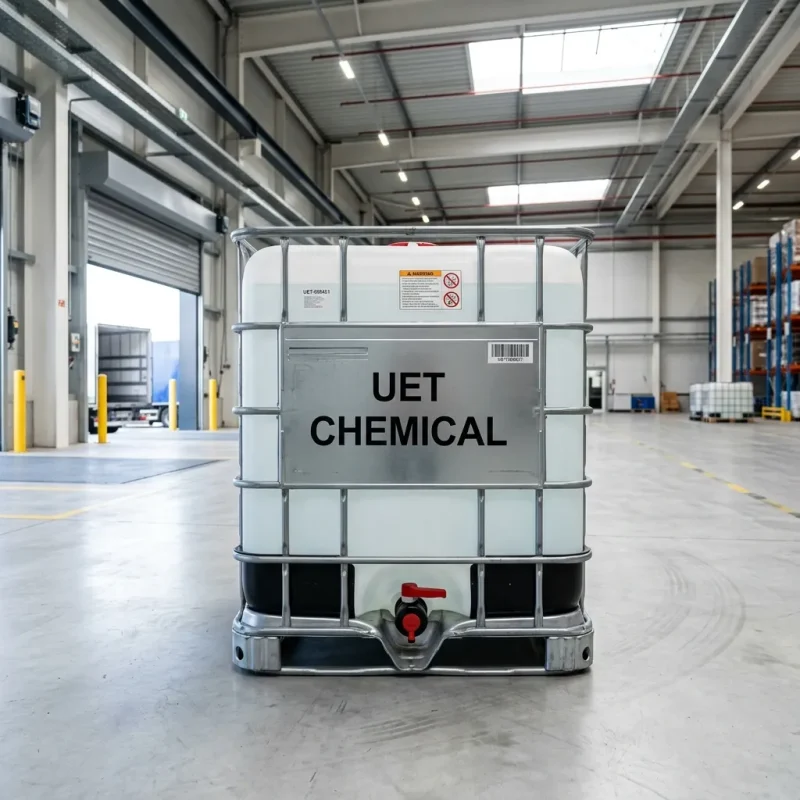
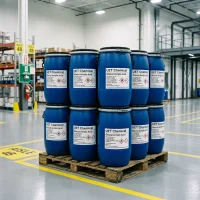
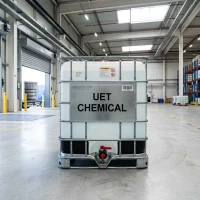
- Packaging: 200 kg (441 lb) HDPE drum, 1000 kg (2205 lb) IBC. Custom packaging available upon request.
- Main Applications: SAP synthesis, acrylic ester production, water treatment polymers, UV-curable coatings
Introduction to Glacial Acrylic Acid
Glacial Acrylic Acid (GAA) is an unsaturated organic carboxylic acid containing both a vinyl group and a carboxyl group on a three-carbon chain. The chemical structure allows the molecule to undergo free-radical addition, homopolymerization, and esterification reactions. At room temperature, GAA exists as a colorless, highly corrosive liquid with a sharp, acrid odor.
The compound exhibits a melting point of 13 °C (55 °F). When ambient temperatures drop below this threshold, the liquid solidifies into ice-like crystals, giving the “glacial” designation. Industrial plants consume GAA primarily as a monomer to manufacture acrylic esters, superabsorbent polymers, and water-soluble resins. The material is typically stabilized with 200 ppm of monomethyl ether hydroquinone (MEHQ) to prevent premature polymerization during transit and storage.
Key Features of GAA
- Vinyl and carboxyl reactivity: The carbon-carbon double bond participates in radical polymerization, while the carboxyl group provides acidity and sites for esterification.
- MEHQ stabilization: Inclusion of 190-210 ppm MEHQ scavenges free radicals, preventing spontaneous exothermic polymerization during bulk storage.
- Glacial crystallization: Solidifies below 13 °C (55 °F), requiring controlled thawing protocols to redistribute the inhibitor and avoid localized hot spots.
- High water solubility: Completely miscible with water, facilitating easy neutralization and subsequent aqueous polymerization processes.
GAA Chemical & Physical Properties
| Property | Value |
|---|---|
| Molecular Formula | C3H4O2 |
| Molecular Weight | 72.06 g/mol (72.06 lb/lbmol) |
| Boiling Point | 141 °C (286 °F) |
| Melting Point | 13 °C (55 °F) |
| Density | 1.05 g/cm³ (8.76 lb/gal) at 20 °C (68 °F) |
| Flash Point | 54 °C (129 °F) closed cup |
| Inhibitor (MEHQ) | 190 – 210 ppm |
| Purity | 99.0% min |
Applications of GAA
Superabsorbent Polymers (SAP): Undergoes crosslinked polymerization followed by partial sodium hydroxide neutralization. This pathway produces the core absorbent matrix for hygiene products, sharing direct chemical lineage with Sodium Polyacrylate.
Acrylic Ester Monomers: Reacts with various alcohols via acid-catalyzed esterification. Reacting GAA with butanol yields n-Butyl Acrylate (BA), a foundational monomer for pressure-sensitive adhesives and latex paints.
UV and EB Curable Resins: Esterifies with polyfunctional polyols to create rapid-cure oligomers. Blending GAA with trimethylolpropane produces Trimethylolpropane Triacrylate (TMPTA), a high-reactivity crosslinker for industrial coatings and 3D printing resins.
Storage & Safety Precautions for GAA
- Temperature and freezing: Store between 15–25 °C (59–77 °F). If GAA freezes below 13 °C (55 °F), the MEHQ inhibitor concentrates in the remaining liquid phase. Thawing must be done slowly with gentle agitation to redistribute the inhibitor; rapid localized heating causes explosive runaway polymerization.
- Headspace and oxygen: MEHQ requires dissolved oxygen to function as a radical scavenger. Never blanket GAA tanks with pure nitrogen. Maintain an air headspace to keep oxygen levels sufficient for stabilization.
- Material compatibility: Use 304L or 316L stainless steel, or HDPE. Avoid carbon steel, which corrodes rapidly and introduces iron ions that can catalyze unwanted side reactions or degrade the MEHQ.
- Field note: Never pump GAA through dead legs or untraced lines in winter. Solidified acid blocks pipes and damages pump seals when forced. Always trace and insulate transfer lines in cold climates.
GAA FAQ
Q: Why does Glacial Acrylic Acid freeze in winter transit?
A: GAA has a melting point of 13 °C (55 °F). Below this temperature, it forms ice-like crystals. To thaw frozen GAA safely, use warm air or water jackets below 35 °C. Never use high-pressure steam, as localized hot spots destroy the MEHQ inhibitor and trigger explosive runaway polymerization.
Q: Why must GAA storage tanks have an air headspace?
A: The MEHQ inhibitor in GAA requires dissolved oxygen to scavenge free radicals. Blanketing the tank with pure nitrogen removes oxygen, deactivating the MEHQ and allowing spontaneous, exothermic polymerization. Always maintain an air headspace and monitor oxygen levels in the vapor space.
Q: How do I handle a runaway polymerization of GAA?
A: If a GAA tank shows rapid temperature or pressure rise, immediately inject a chemical inhibitor kill shot (like PTBC) and apply external water cooling. Do not open the manway, as sudden oxygen ingress can sometimes accelerate the reaction if the mixture is highly concentrated and hot.
Related products
Manufacturer & Exporter Since 2006
Get Tailored Chemical Raw Material Solutions — Reply Within 1 Hour
Factory-direct pricing, stable high-purity supply and complete compliance documentation for your industrial formulations.
- 1000+Products
- 200+QC Protocols
- 7–15Days Delivery
- Factory-Direct Pricing
- COA / TDS / SDS Included
- Free Samples for Testing
- 40+ Export Countries
Request a Free Quote
Our engineers reply within 1 hour during GMT+8 business hours.
Please include in your inquiry:
- Product name or CAS number
- Required quantity
- Destination country or port
- Preferred packaging